Masobu
An adult gaming platform
by Model Media.
As piracy put severe pressure on the group’s adult-video revenue, we set out to build a new business around games: original development, creator publishing, a storefront, player communities and membership.
I joined as Associate Operations Manager, translating audience research and day-to-day operating needs into the platform MVP. My work connected platform development, game production and creator partnerships.

From operating a platform
to helping shape it.
I connected player, creator and operations needs with product development.
2024, in numbers.
Prelaunch · Brand & audience
A world to recognize.
An audience to understand.
We developed a playful identity and studied Model Media’s existing audience to shape the platform’s first games and launch priorities.

Made for play.
Model Media meets asobu—Japanese for “to play.”

gaming
stories
audience
Start with the audience
we already knew.
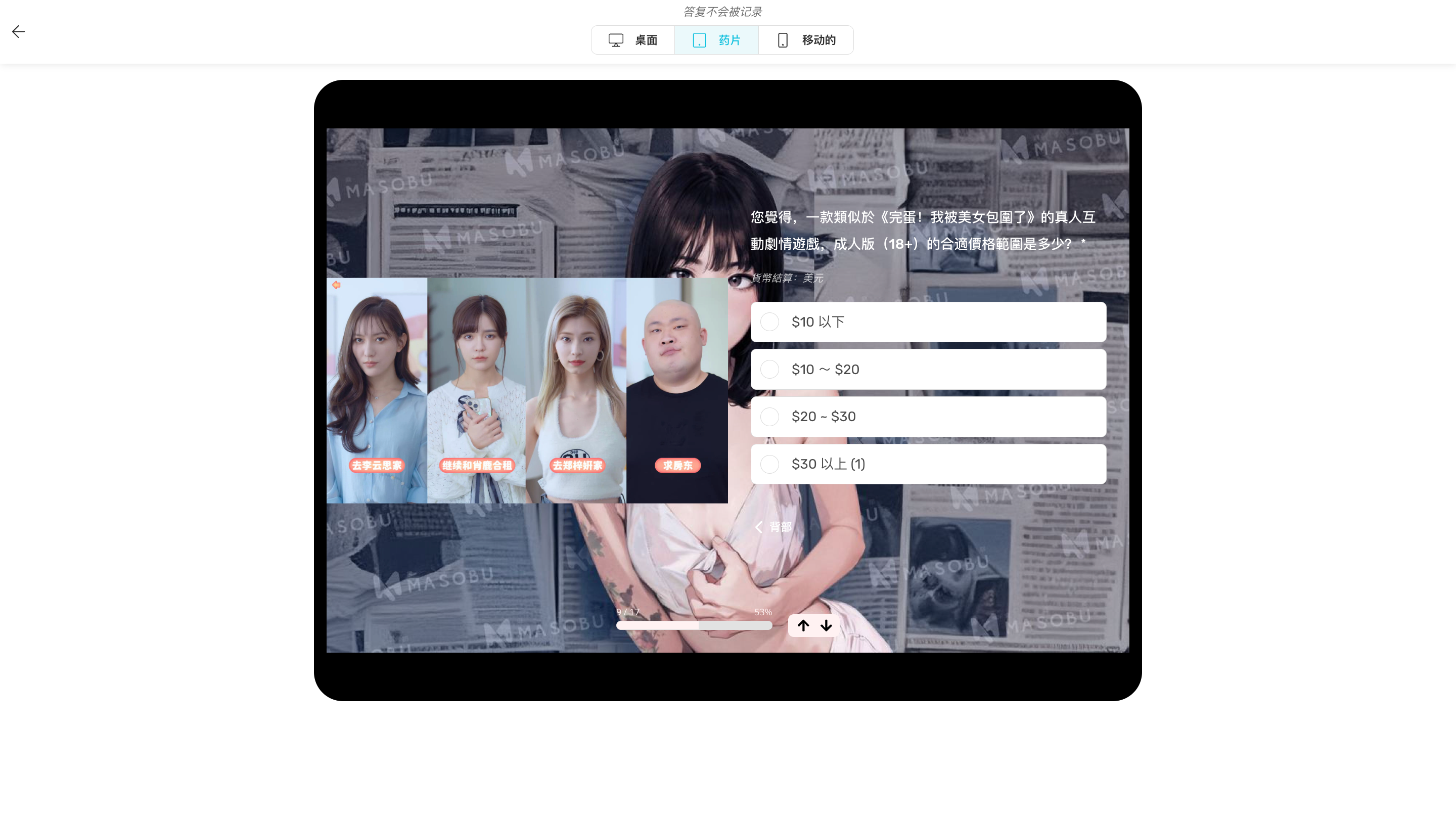
Our adult-video audience was the most cost-efficient starting point. Research and a core-user survey validated live-action games and visual novels.
Platform MVP · Collaborative product design
Three priorities.
A much bigger product.
Three MVP priorities from a broader product scope I shaped with the product manager, balancing players, creators and operations.
Operating systems · One connected framework
The systems
behind the platform.
Payments, releases and analytics—designed to work together.

$0.02 in rewards
at the minimum top-up
One purchase.
A reason to return.
Coins paid for games; points rewarded spending. We designed eight top-up tiers, with higher reward rates at larger amounts.
Tier sizes followed the pricing of our lead games, leaving a small coin balance after a purchase to encourage a return visit.
Different teams.
One release rhythm.
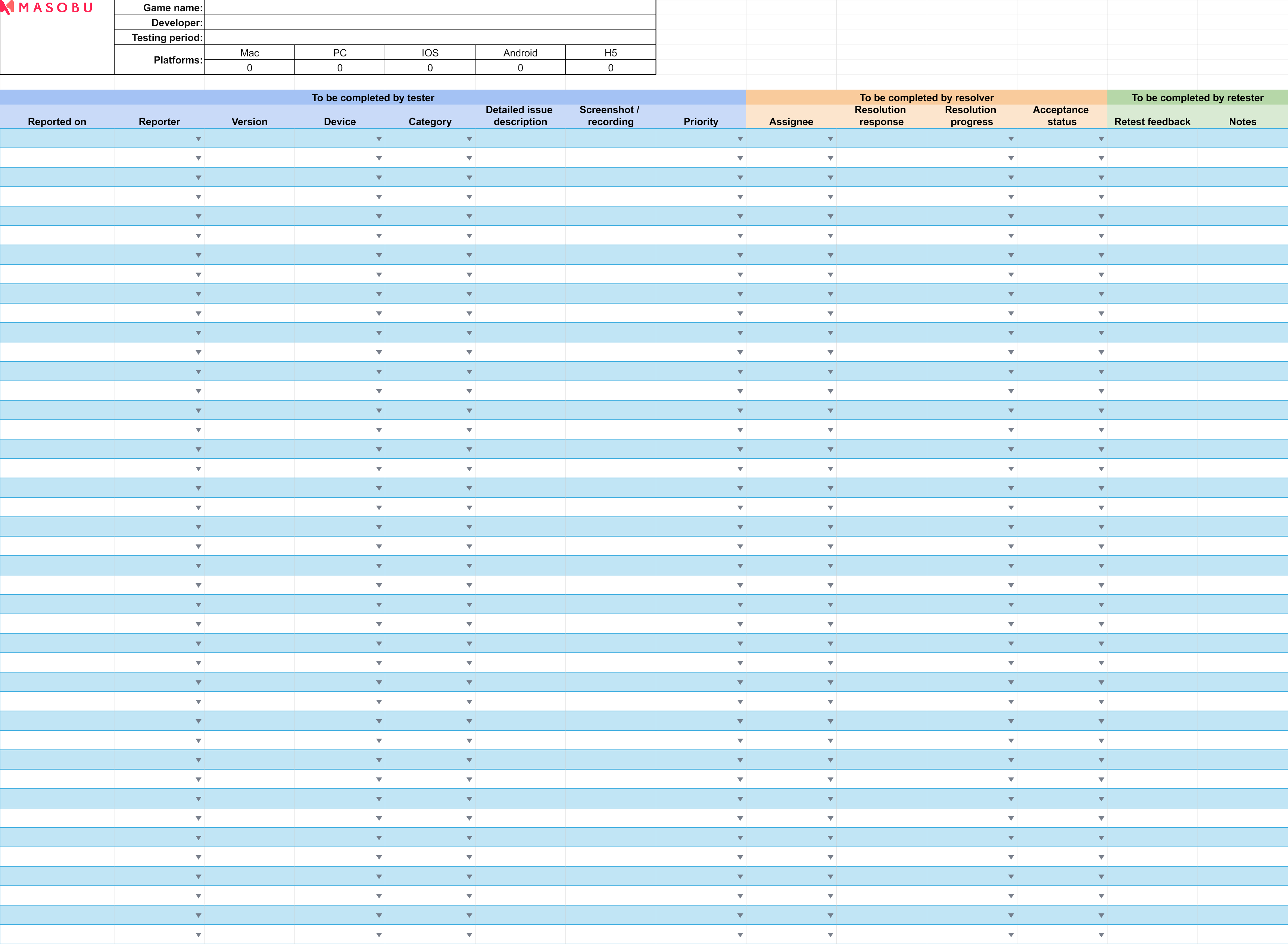
I coordinated in Asana and collected team deadlines in a shared workbook, aligning production with marketing, SDK integration and launch readiness.
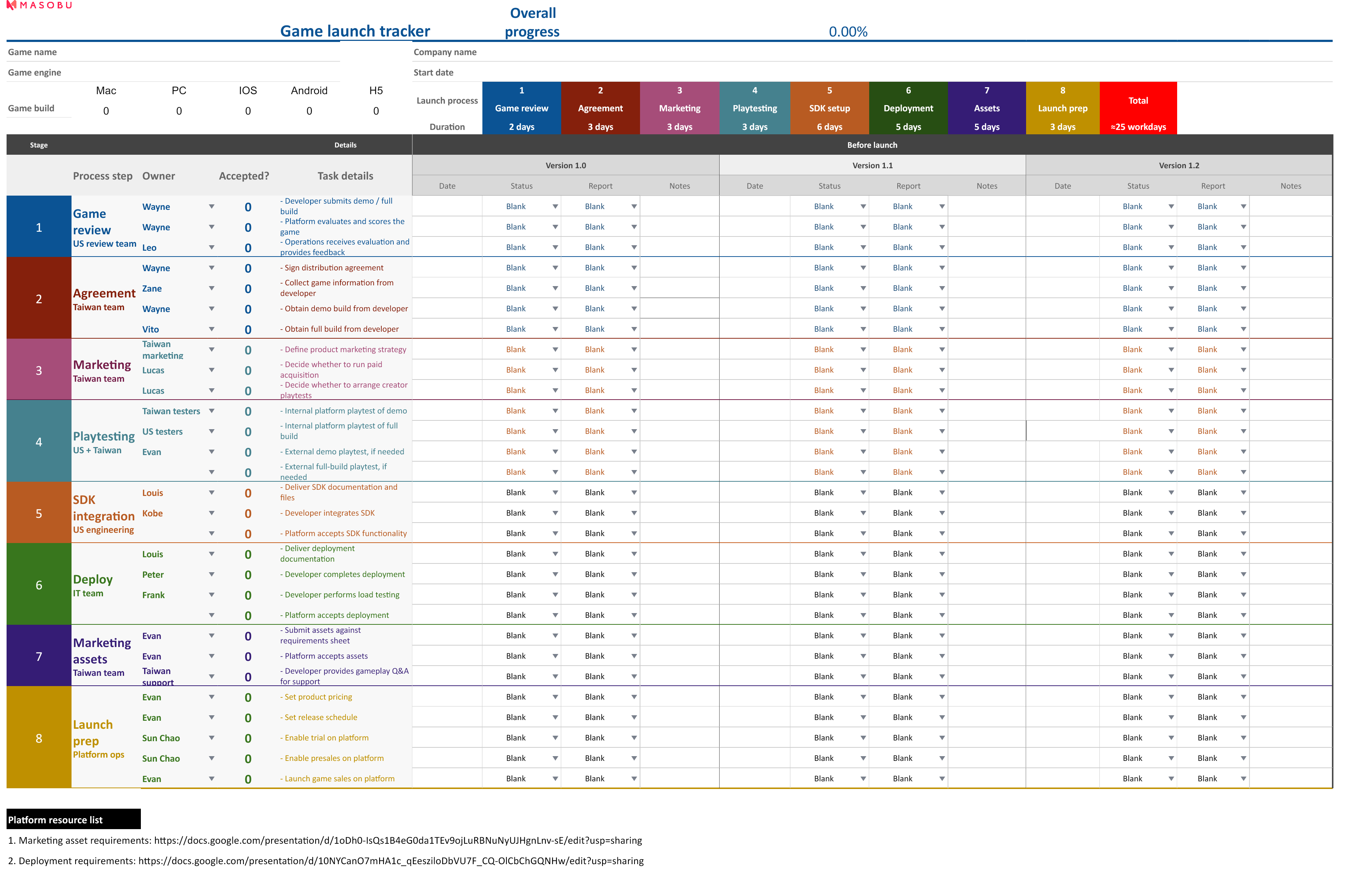
From requests
to releases.
I turned operational needs into product requirements, then tracked priorities, versions and delivery with engineering—from SDK purchases to account flows and payment analytics.
How we measured
the platform.
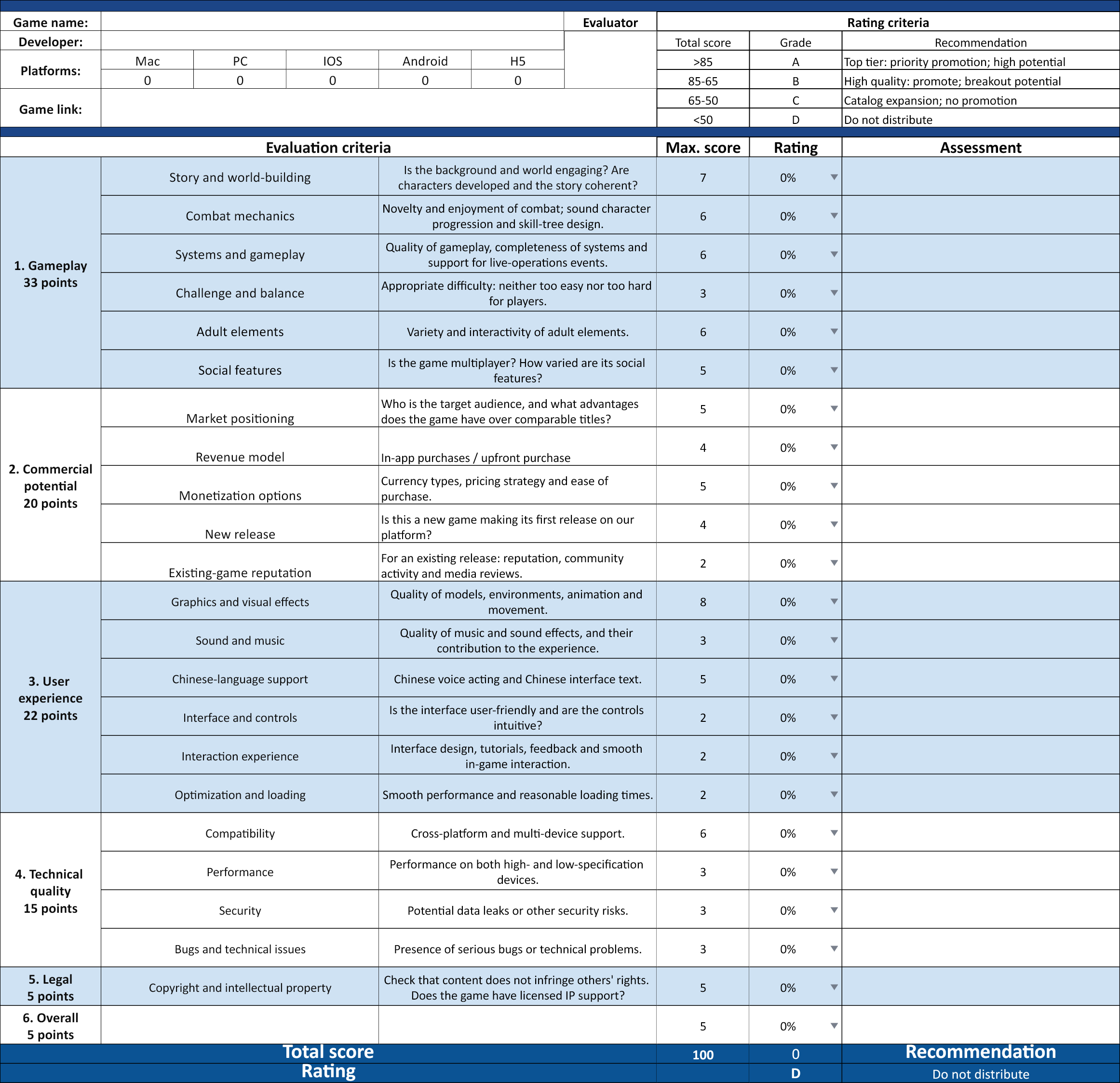
My measurement framework: the calculation, population and timing behind each metric.
In-house production + Community
From webtoon
to playable world.
Sex Stopwatch
A meeting point between in-house production and our creator ecosystem: we licensed TOPTOON’s IP and built the game with community artists. I initiated the project, led production and handled paid media, social campaigns and launch promotion.


 Licensed for adaptation
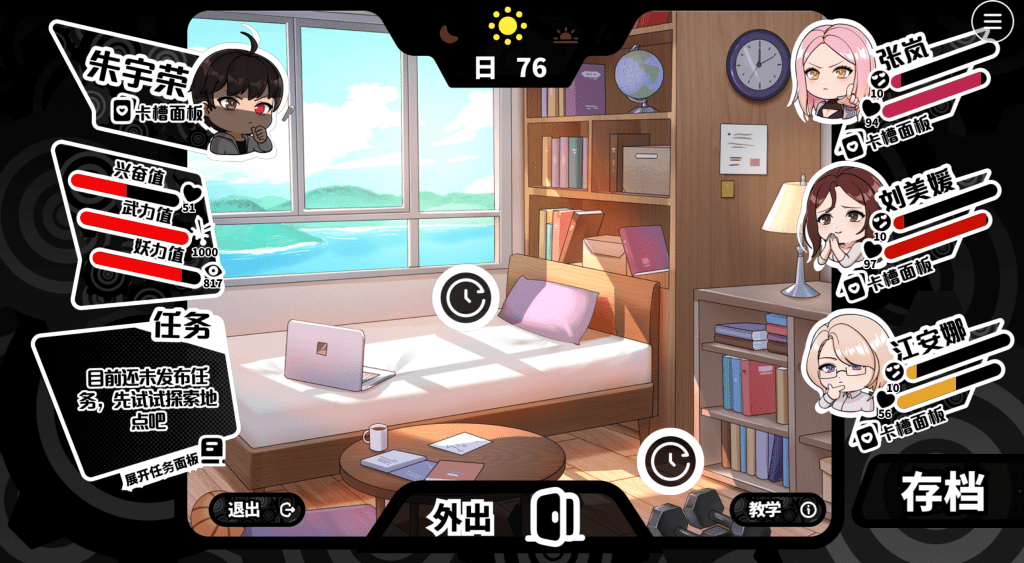



A community behind the games.
I recruited artists and developers through offline events and Discord. Contests brought in game proposals; selected teams received our licensed IP and production support.
67 comic artists
11 game developers
3 enthusiasts
Talent, backed by a team.
I led the project teams, coordinating funding, backend support, marketing and distribution. Creators received milestone awards and a share of game sales.
- Demo$8,000
- Initial build$20,000
- Later milestones$50,000
The game library · The next chapter
A world of games.
Our catalog covered visual novels, action, RPGs and live-action interactive stories, across standalone buy-to-play and online games. We also built a Cocos2d-based editor so creators could assemble games from reusable modules and reduce development effort. The catalog now continues at YouDianSe.
when I left

Sexy Click
MASOBU · Live-action
The Hardest Interview
MASOBU · Live-action
Lust War
Anime · Card strategy
Courtesan Dynasty
Illustrated · Simulation
Soulbound Desire
Anime · Strategy
Zombie Showgirl Showdown
Anime · Tower defense
Irresistible Encounters
Illustrated · Simulation
Star Railed: A Cosmic Journey
Anime · Story adventure
Desire Dreamworks
Live-action simulation
Neptune Legend
Live-action interactive
They All Say I’m a Playboy
Live-action interactiveThe project continues at YouDianSe.
My most complex project so far—and the experience that brought me closer to development, connecting business rules, product design and creative production.
Masobu → YouDianSe
User accounts and games have migrated. Legacy player accounts and assets have been restored.
Visit YouDianSeMarket Insights on Live-Action Interactive Adult Games
Research type: Qualitative · Researchers: Evan, Leo
Background
Restrictions, including legal restrictions, have prevented adult games from becoming a large-scale industry in Chinese-speaking markets. Nevertheless, the circulation of pirated games and activity on adult forums suggest substantial unmet demand. Across Asia, Japanese games have gained influence through their early start and scale. Anime-style female characters serving as fantasy figures or virtual girlfriends have long been a central theme.
As audiences change and live-action interactive dramas and video games—such as Love Is All Around—reach wider audiences, we see an opportunity to take a different route. We plan to combine adult games with interactive video: the immersion of a filmed story, identification with live-action content, and the enjoyment of game-like interaction. Our objectives are to investigate related industries, estimate their scale and potential problems; identify core and opportunity audiences; and synthesize recommendations.
Research approach
Live-action interactive adult games span games and filmed entertainment. Because Japan leads the adult-game industry, we first examine its changing business models and game formats to identify potential growth. We then study the history of Japanese adult games in Chinese-speaking markets to understand the current landscape. Next, we consider popular Chinese web novels, short dramas and interactive video, examining their weaknesses and competitive strengths. Finally, Love Is All Around provides a starting point for understanding the origins and substance of interactive video games.
Trends in Japanese adult games (eroge)
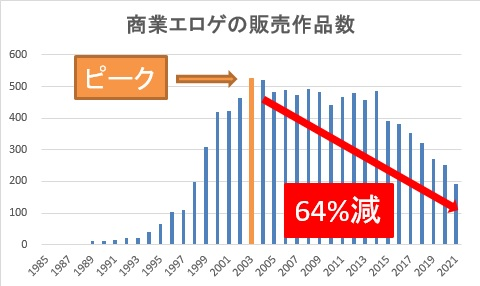
According to Rainer, an experienced DLsite R18 forum moderator, commercial adult-game releases reviewed by Sofurin [1] peaked at 526 in 2003. They declined gradually through 2014, then fell sharply to 391 in 2015 and 191 in 2021—about 64% below the peak [2]. Market size reportedly fell from JPY 60 billion in the early 2000s to JPY 10 billion in 2021, a decline of more than 80% [3,4].
Here, commercial adult games means adult-oriented games made by larger studios from their own intellectual property, often adapted from novels and sold as packaged discs through retail channels. Research by Yano Research Institute [5] links the decline to extensive unauthorized use and piracy. Digital change, including computers without built-in disc drives, also made channel transformation urgent. More fundamentally, these games lacked sufficient variety in content and format to meet changing demand. Long IP development cycles and resistance to change among an older generation of creators compounded the problem. Attempts at innovation after 2010 did not reverse the decline.
Source notes
[1] Games reviewed by Sofurin, distributed as packaged products or downloads.
[2] ErogameScape, a veteran-player website aggregating release information from platforms and publishers with SQL. These are game-registration counts.
[3] Market figures: Sapporo monthly publication for the period beginning in 2003; Yano Research Institute for 2006–2021.
[4] Rainer, “The Decline and New Directions of the Eroge Industry Seen Through Annual Release Counts,” 2022.
[5] Yano Research Institute. The supplied document provides no further bibliographic detail.
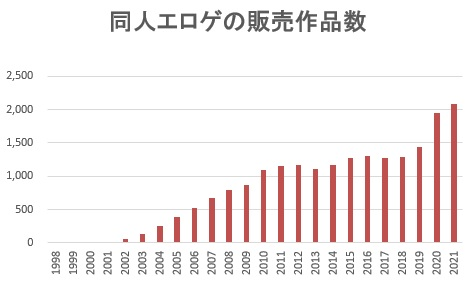
From commercial releases to doujin ecosystems
Meanwhile, lower technical barriers and new generations of IP supported growth in Japanese doujin releases: from 135 in 2003 to 2,085 in 2021 [6]. Doujin works are fan-created adaptations or derivatives of original works and IP. Compared with commercial productions, their barriers are lower and their formats more diverse, including light novels, manga and fan publications. Widespread online payment allowed promotion and sales to move from offline channels to digital ones. Original authors' tolerance of fan creation also encouraged platforms such as FANZA and DLsite to commercialize these works and aggregate audiences.
More releases rebalanced supply and demand. Lower costs and the transparency of digital storefronts made doujin products more competitive. A well-made doujin game can now cost around JPY 1,000 in a sale, compared with the JPY 8,000-plus prices common for commercial games in the past.
Text-heavy romance games—mainly ADV/AVG titles and some SLG titles—lost dominance. An adult-game practitioner writing at ErogetoBook stated that all of FANZA's top 20 games at the end of 2020 were non-novel games [7]. 3D simulation and RPG titles emphasizing character movement and mechanics, such as Custom Maid 3D2, and newer social consumption formats gained share. Carefully written dialogue and background music may no longer carry the same weight by themselves.
Adult-fiction author Hiroyuki Kagami offered a broader explanation: Fate's success in 2004 signaled growing interest in light novels and manga requiring less reading. Smartphones and the internet further fragmented free time and raised the priority of immediate visual impact. On that interpretation, future formats would increasingly emphasize speed and directness [8].
The development can be described in four stages: large studios pioneering their own IP; light novels and illustrations stimulating doujin creation; mobile devices and technology changing user needs; and doujin growth producing platform ecosystems. In distribution, users prefer digital channels combining variety with transparency, where feedback can influence price and quality. In content, they favor faster and novel formats that fit fragmented leisure time without demanding excessive commitment.
Japanese adult games in Chinese-speaking markets
Source notes
[6] ErogameScape, doujin games grouped by registration year.
[7] “Is the Decline of Eroge Real? Examining the Adult-Game Market Through Data,” 2020.
[8] Hiroyuki Kagami, “Seven Reasons New Adult Games Do Not Sell Well,” 2016.

Two routes into Chinese-speaking markets
ILLUSION's overseas expansion offers a useful starting point [9]. It was among the first Japanese studios recognized in China. From around 2000, popular titles including the Tail and Imprisonment series received fan translations. Unlike studios centered on text-heavy romance games adapted from novels and scripts, ILLUSION emphasized new 3D formats and became a defining studio for a generation of players.
Legal constraints prevented an official mainland entry. Access was largely limited to pirated forum downloads and expensive resellers. These channels nevertheless gathered dedicated adult-game enthusiasts and established the foundations of today's Chinese ACG forum networks. Around 2010, China and Japan underwent similar digital changes, creating both demand for doujin works and technically capable creators.
New users and creators entered the established forums. A distinctive commercial model emerged: pirated games and original doujin works formed the content pool; forums provided aggregation, variety and transparency; advertising and commercial partnerships monetized the traffic. More recently, non-ACG video sites including Laowang Forum and Sijishe also entered the space, earning intermediary margins through resource bounties and paid exchanges.
Traditional Chinese-speaking markets, led by Taiwan, followed a different route. Japanese adult games could enter through public channels, leading to officially localized commercial and doujin titles, as illustrated by DLsite Taiwan. Chinese-speaking creators also began developing local works, contributing to platforms such as Erolabs and Ero18. Pirated-resource sites, including JKF, also moved into games around 2015. Broadly, however, the commercial landscape combined Japanese and local developers selling legitimate localized games, with platforms supplying variety and transparency.
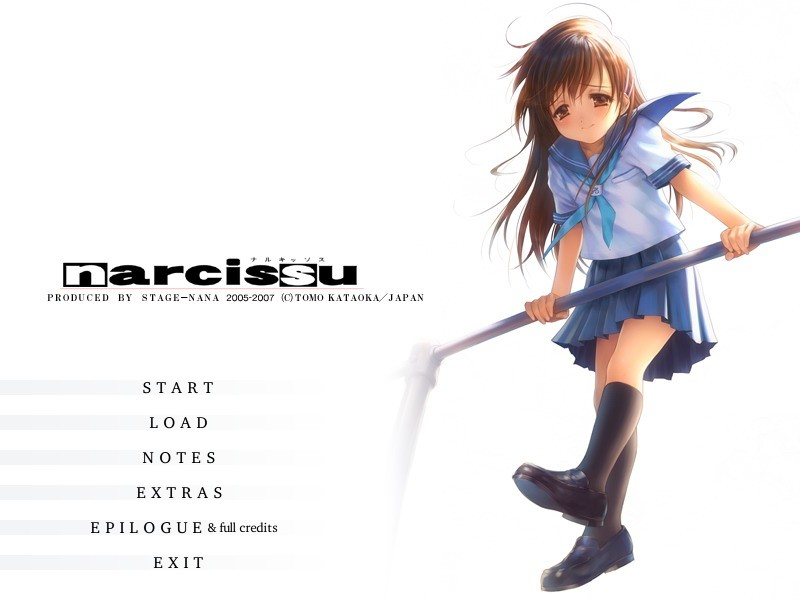
In a 2022 BugBug interview, Naohiro Nakamoto, the Japanese representative of SEKAI PROJECT [10], discussed Narcissu creator Tomo Kataoka's overseas expansion. He estimated that China represented about 45% of the global adult novel-game market. He attributed this not only to population size but to a younger, educated audience with reading habits. In his view, fewer young Japanese users were enjoying long-form reading, while some light-novel sites were moving toward manga [11].
That view suggests mainland China resembles Japan's earlier period, with text-heavy romance games dominant. However, it may overlook large adult-game forums. Our rough review of mainland forums found ADV/AVG shares between 9.24% and 13.76%, close to the 14.99% novel-game share on DLsite. Conversely, more than half of the resources circulating in enthusiast communities listed by ACG Box [12] were text-heavy romance games or classic commercial titles, supporting Nakamoto's observation about a dedicated audience.
Source notes
[9] ILLUSION was an adult-game brand of Yokohama-based IONE Co., Ltd.
[10] Sekai Project is a US publisher best known for translating Japanese visual novels into English and distributing them internationally. Its catalogue also includes original English visual novels, manga and other games. Narcissu is cited as an overseas-release example.
[11] BugBug, interview with SEKAI PROJECT's Japanese representative Nakamoto, March 2022.
[12] ACG Box is a directory of ACG-related websites and communities.
Market implications
Piracy does not translate directly into commercial revenue. Japanese paid channels such as DLsite and FANZA also restrict access by IP address, making Steam one of the few legitimate routes into mainland China and Simplified Chinese audiences. Official Chinese localizations represented roughly 8% of doujin games sold on DLsite in March 2024 [13], indicating creators' attention to Chinese-speaking buyers, particularly Traditional Chinese regions and overseas Chinese audiences, including those in Japan.
We draw two inferences. First, mainland China retains an established audience for adult novel games, concentrated on Steam and ACG piracy communities. Applying the cited 45% share to the 2021 commercial market of JPY 10 billion suggests a market below JPY 4.5 billion. This is an estimate, not measured mainland sales. Declining Japanese demand for ADV/AVG and the strong referral effects of ACG communities can increase Chinese players' relative share. Second, Chinese demand for doujin adult games may grow along a similar path to Japan, but legal channel restrictions and piracy limit penetration by Japanese publishers.
Forum sample
| Site | Traffic over the last three months | Chinese-speaking traffic | Chinese share | ADV/AVG | ACT | RPG | SLG |
|---|---|---|---|---|---|---|---|
| Illusion China | 176,842 | 135,726 | 76.75% | 9.24% | 3.64% | 27.45% | 59.67% |
| Weika ACG | 1,777,000 | 1,297,032 | 73% | 12.83% | 9.63% | 50.80% | 26.74% |
| Sijishe | 2,993,000 | 1,450,408 | 48.46% | 11.03% | 6.38% | 24.98% | 57.61% |
| Laowang Forum | 8,577,000 | 4,884,602 | 56.95% | 13.76% | 5.78% | 33.78% | 46.68% |
Web novels and short dramas
Immersive wish fulfillment, repeated melodramatic reversals and familiar romance tropes helped make short dramas—and their overseas expansion—a major topic by late 2023, when Stephen Chow entered the field. The source forecast a RMB 50 billion short-drama market in 2024. Understanding the appeal begins with web fiction, a major source of scripts.
Chinese web literature developed in three stages. In the 1990s and early 2000s, internet access was uncommon and online writing largely resembled traditional literature. From the early 2000s to 2010, computers and mobile phones spread, paid reading emerged, and fantasy and romance became leading genres. Platforms including Qidian and Jinjiang grew rapidly. Qidian, founded in 2002, experimented with paid reading and established an online publishing model for copyrighted works. After 2010, mobile internet and smartphones supported more than 200 genres; monthly active users reached 230 million by 2020. Platforms had to keep developing product features and interaction to increase engagement and retention.
Readers shifted from the post-1980 generation toward post-1990 and post-2000 cohorts. The cited general web-literature study reported that ages 14–19 represented 36% of readers. Writers were also changing: post-1990 authors became a core force and post-2000 authors grew in number. Peking University professor Shao Yanjun observed that the youngest writers grew up with a deeper digital imprint.
Source note
[13] DLsite's Chinese-localization tags on doujin titles available in March 2024. The age statistic above concerns general web literature, not the intended audience of an adult platform.
Why serialized stories keep audiences returning
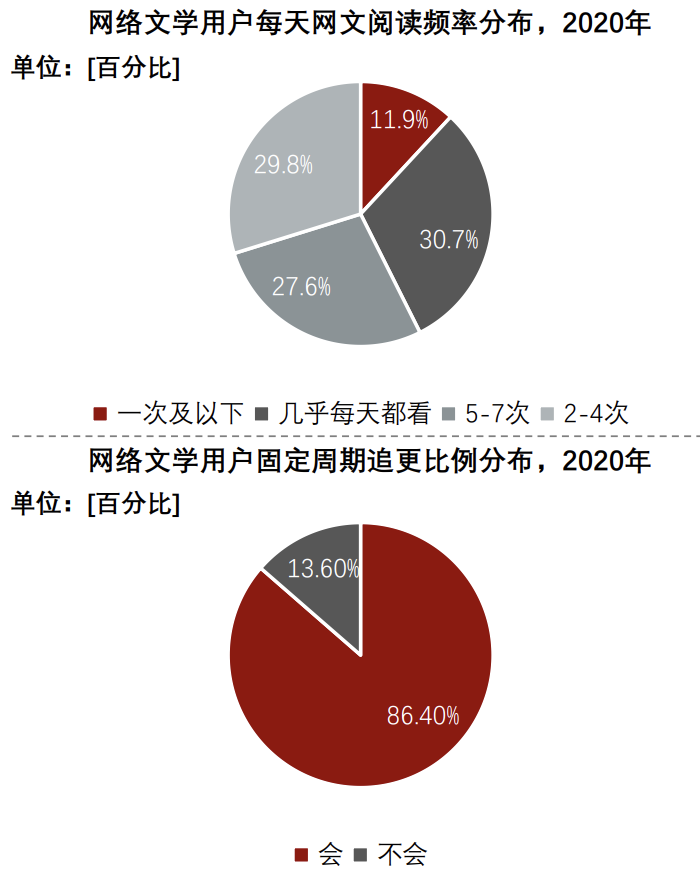
The source continues Shao Yanjun's observation: younger creators work with digital technology and AI in ways distinct from traditional literature. Among web-fiction readers, 30% reportedly read almost every day, 29% read two to four times daily, and 87% follow updates on a regular schedule. Serialization encourages return visits, while authors can change a story in response to readers. The source describes typical long works of around 3,000 chapters, each containing 2,000–3,000 Chinese characters, with paid chapter unlocks averaging RMB 0.12 each [14].
Web novels have become longer: one million characters can count as a medium or short work, and ten-million-character stories are not rare. Two developments explain the expansion. First, a broader social and imaginative range—fantasy, tomb exploration, multiverses, science fiction and apocalypse—combines with time travel and alternate histories to extend narrative possibilities. Second, the medium changes the function of description. Physical books have limited space and often summarize events; mobile reading permits much more detailed, lifelike description and prolonged immersion in imagined worlds.
Long works nevertheless tend to move through repeated small climaxes toward a final peak. Each chapter needs a satisfying moment, sometimes several, to keep readers following. The first 30,000 characters must establish the hook, subject and world. By around 200,000 characters, a reading habit can form, requiring either a backlog or consistent updates. Skilled writers turn that habit into a strong compulsion to continue.
Short dramas developed through two routes. Traditional film production adapted its expensive, lengthy model into low-cost, fast-moving stories for small screens. At the same time, web-fiction groups used their IP directly in inexpensive dramas, moving beyond licensing to reach viewers themselves. Tuiwen Technology CEO Tong Ye explained that a user who once spent RMB 200 and two months reading a novel could consume the equivalent content in two hours of short drama; the market was pushing fiction toward video.
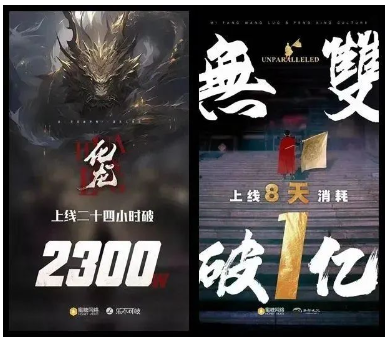
Practitioners classified productions as popular, breakout or phenomenal based on advertising expenditure and industry response. The supplied source prints the popular tier as “RMB 8 million to RMB 1 million”; the reversed range is retained as an unresolved source inconsistency. It gives RMB 20–30 million for breakout productions, and RMB 30 million-plus with wider cultural reach for phenomenal ones. Examples include Wushuang for male-oriented audiences and The Empress Comes to Work for female-oriented audiences [15]. Phenomenal titles were rare, but the source estimated two or three breakout titles a month during 2023, including Hualong and My Monthly Salary as a Stand-In Is One Million.
Practitioners summarized three principles: visually stimulating presentation, an easily followed plot and brisk emotional payoff. Pace and reversals matter throughout, but the opening episode and first ten episodes are especially important.
Source notes
[14] Huang Yi, Overview of China's Online Literature Industry, March 2021.
[15] Wang Lu, “Mass-Producing Hit Short Dramas,” November 2023.
The first ten episodes
Within a first episode of two or three minutes, a short drama should introduce its leads and a conflict. Another reversal in the next two or three episodes builds tension and encourages the next click. The first ten episodes matter because episode ten is often a payment point, and because completing that sequence can establish a viewing habit. Episodes 1–4 introduce the world, principal characters and central plot; episodes 5–8 intensify both events and emotion; episodes 9–10 leave a hook strong enough to prompt payment.
Male-oriented “war god” stories emphasize repeated triumph: the hero appears weak, antagonists underestimate him, and the audience enjoys increasingly satisfying reversals. Female-oriented revenge stories center on emotion. Early hardship must build sympathy for the heroine, while antagonists continually create trouble. The source contrasts the deliberately disbelieving antagonist in male-oriented stories with the relentlessly troublemaking antagonist in revenge stories.
Interactive video in China
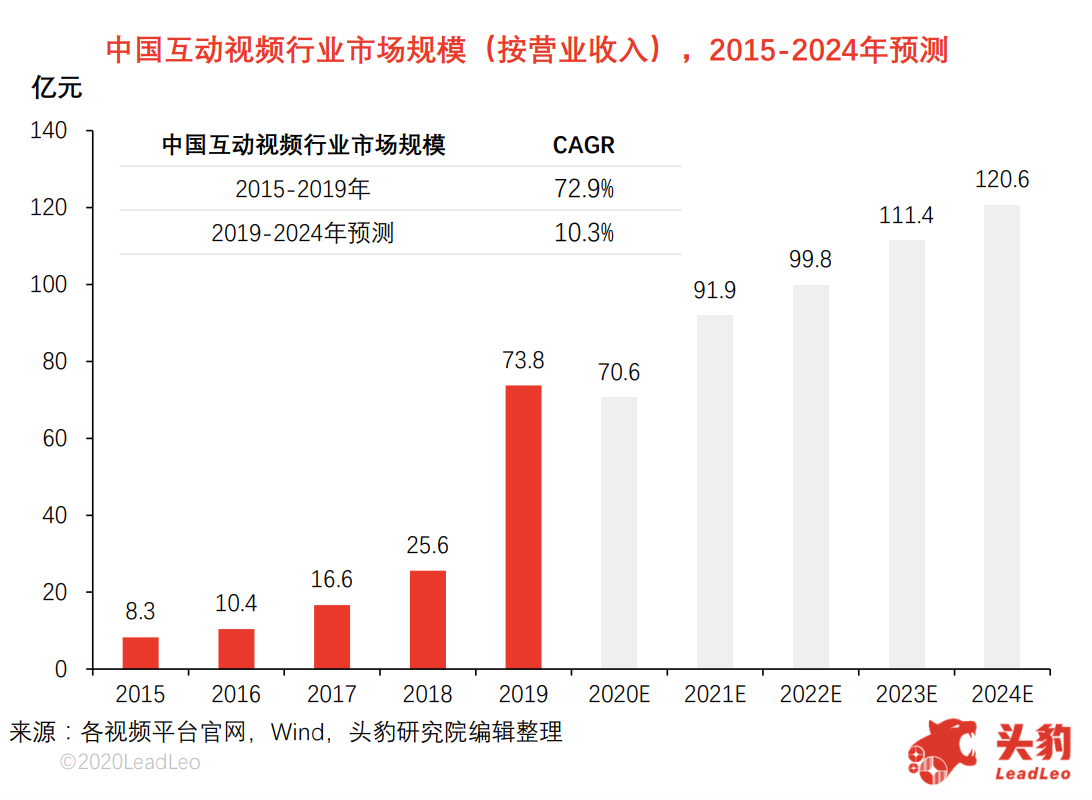
LeadLeo Research Institute's 2020 industry overview [16] estimated a RMB 7.38 billion interactive-video market in 2019 and forecast RMB 12.06 billion in 2024, roughly 10.3% annual growth. These are historical estimates and forecasts from the supplied research.
Demand came from both audiences and platforms. According to data cited from the China Television Drama Production Industry Association, leading web dramas recorded 400–600 million plays in 2019, but only 20–40% qualified as effective viewing: more than 20 continuous minutes without fast-forwarding or increased speed. Short video, with its variety and personalization, overtook long video in scale at the end of 2019. In leading dramas rated above seven on Douban, about 20% of negative reviews concerned dissatisfaction with the plot. Together, these observations suggested demand for interaction and story choices.
Platforms faced their own pressures. The research reported a decline of about 1.6 million, or roughly 5%, in content growth for UGC-led long-video services such as Bilibili from 2018. PGC-led services such as Tencent Video faced repetitive content and declining retention: next-day retention was cited as 38% at the end of 2019, down 10% from the previous year. Faster production, stronger reviews and retention therefore became priorities. Interactive video offered an appealing combination of flexibility, novelty and productive formats.
The history of the format helps explain its appeal. A China Film News discussion [17] describes feasibility work and tests by film producers as early as 2011, centered on giving audiences more participation in a story.
Source notes
[16] LeadLeo, a China-based industry research and digital research-services provider; Overview of China's Interactive Video Industry, 2020.
[17] Lin Lin, “Interactive Film: A New Species Connecting to the Future,” China Film News, 2019.
Interaction must serve the story
Early interactive films offered A/B/C branches at key turning points, resembling choices in Japanese simulation games. Tests exposed three problems: production costs for branches were difficult to spread efficiently across choices; playful interruptions broke the continuity of viewing; and majority voting in cinemas placed pressure on users whose choices lost. Producers subsequently added more independent, strategy-like tasks, such as helping a protagonist escape, to maintain satisfaction.
As digital technology advanced, Late Shift arrived on Steam in 2016. Individualized stories became more practical, with 180 decision points and seven endings illustrating the combination of interactive video and games. Black Mirror: Bandersnatch took the format further in 2018: five final endings, a shortest route of 40 minutes, average viewing of 90 minutes, and a reported trillion possible combinations of story segments.
Mystery and adventure examples earned strong reviews but revealed additional weaknesses. Large narratives needed excellent source stories or IP. Wrong choices could force failure and repetition, consuming time and causing frustration. A limited interaction vocabulary became increasingly repetitive over longer sessions. Chinese video platforms and film companies consequently entered the field with improved interaction as a central challenge.
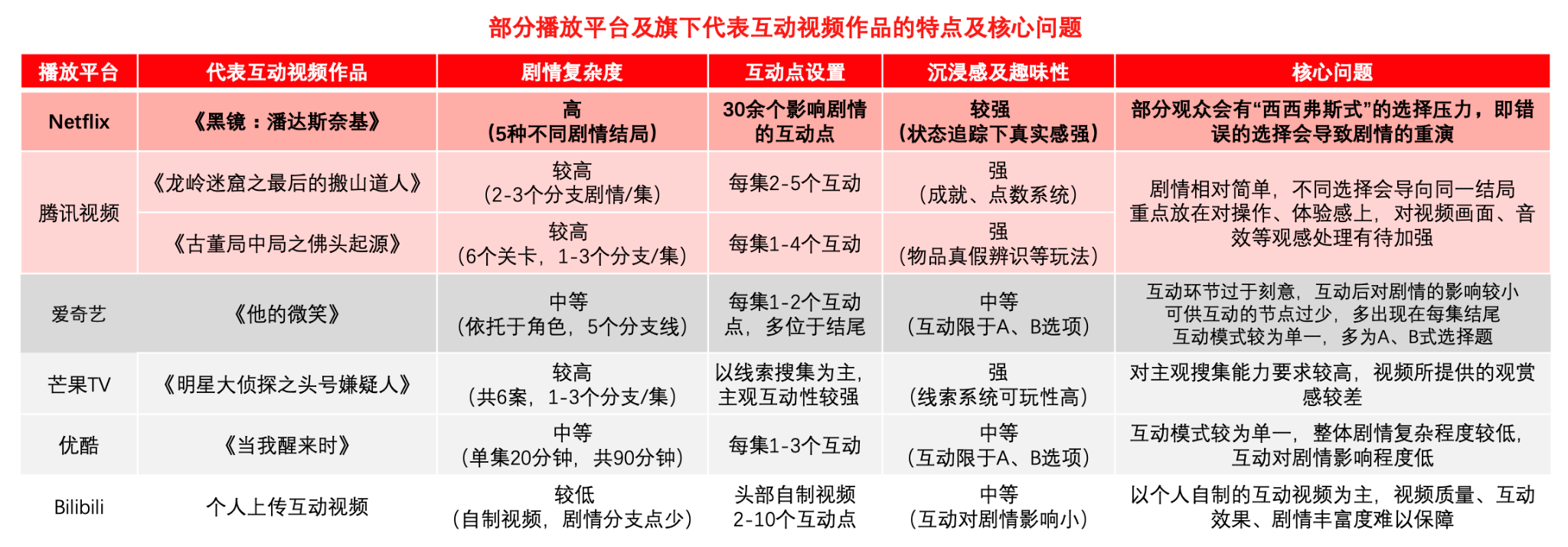
After 2019, Tencent Video released adventure titles including The Origin of the Buddha Head and The Last Mountain-Moving Taoist. The latter introduced data and character achievements. The source reports 51.789 million plays, 2.238 million completed endings and a 15.2% replay rate. Notably, 65.3% of users deliberately selected failure to discover alternate-branch surprises, contrasting with the fear of wrong choices reported for Bandersnatch. Reviews were generally positive.
iQiyi published an interactive-video standard and supporting production tools. In early 2020, Youth With You 2 allowed viewers to switch perspectives, showing possibilities beyond scripted drama. However, rapid expansion encouraged both shallow and excessive interpretations of interactivity: operational tasks could displace the pleasure of watching, while artificial A/B choices at unimportant moments added little.
The accompanying source comparison [18] presents examples and their limitations. Interaction alone can blur the distinction between a film and a game while weakening both. Its useful role is to support a coherent story and add meaningful content, allowing each viewer to experience a personal route. Even with these limitations, interactive video offers enough distinct enjoyment to support a substantial niche beside conventional video.
Source note
[18] Ma Axin, “Constraints on China's Interactive Video Industry,” Overview of China's Interactive Video Industry, 2020.

The interactive-video value chain
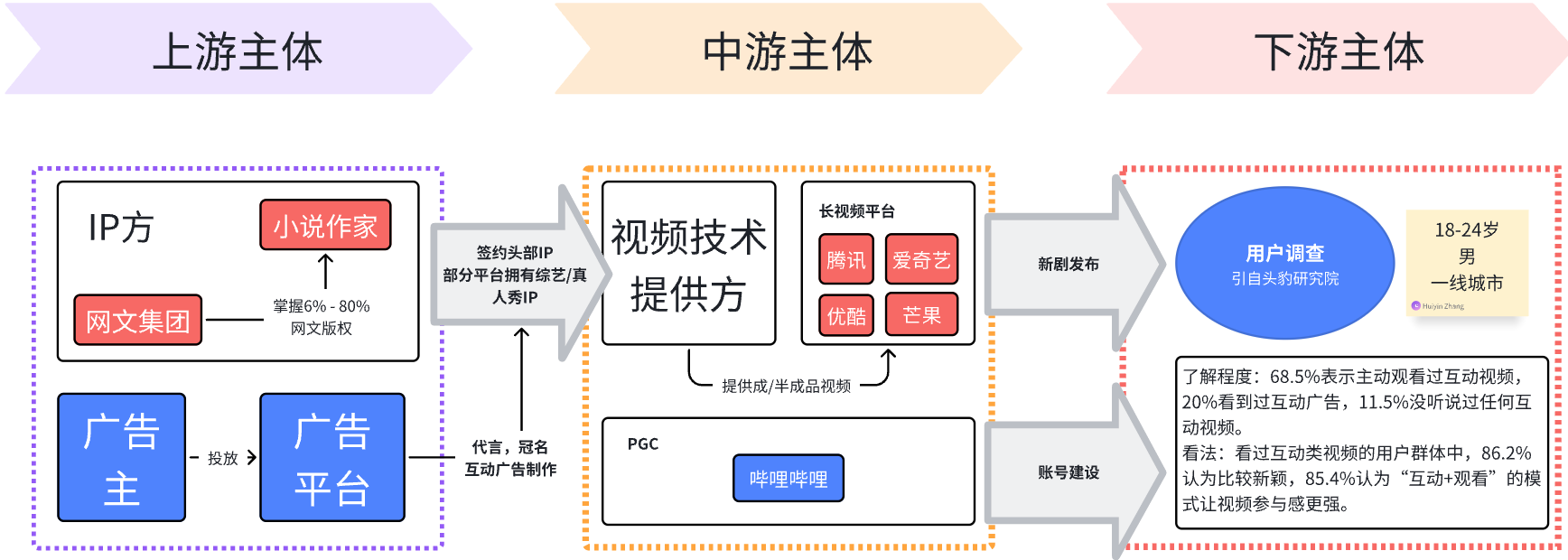
The source industry-chain diagram [19] identifies three principal groups. IP owners and novelists control much of the writing suitable for interaction, while advertisers represent substantial funding and demand. Large long-video platforms hold non-scripted IP that can be adapted, typically in partnership with production companies; creator-led platforms need technical support to enter the field. Younger audiences express expectations for interactive video and more varied content.
This raises questions about future structure. Could technology providers offer production tools to the general public? Could competition encourage IP owners to permit more derivative creation? If so, the existing value chain may change.
Love Is All Around
The Chinese live-action romance game Love Is All Around launched on Steam in October 2023 and topped the Chinese bestseller chart for several days. It used an upfront price of RMB 42, with a RMB 19 DLC. The research cites estimated sales of one to two million copies. As of 13 April 2024, it recorded 373 concurrent players, a 24-hour peak of 1,307 and an all-time peak of about 65,000.
Players take the role of a male protagonist pursuing relationships with several female characters played by live actors. Features include affection scores, skipping and selecting story nodes, achievements and an image gallery with bonus material.
Source note
[19] Ma Axin, “China's Interactive Video Industry: Industry Chain,” Overview of China's Interactive Video Industry, 2020.
A romance short drama inside a game
The game contains five chapters, twelve endings and more than a hundred branches. Scenes form nested units of roughly five to seven minutes. Each chapter's main route has about eight to twelve choices; more than half do not directly change the plot or ending. Instead, they change affection, trigger side stories and accumulate toward relationship achievements. A fast single-route chapter takes around 30 minutes, producing a choice about every three minutes, with intervals from more than one minute to no more than seven. One character and ending across five chapters can take about 2.5 hours; all characters and endings take more than ten hours.
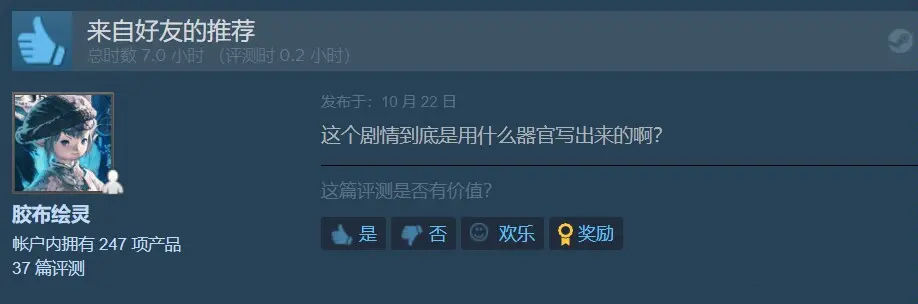
The research interprets the game's core as an interactive romance short drama. Interactive romance became a focus for major video platforms around 2019, but unlike well-received mystery adventures, many titles suffered from awkward melodrama, exaggerated acting and unconvincing choice points. Examples such as His Smile and Boom! Boom! averaged around five on Douban despite total running times around 270 minutes. Viewers reported little interest in interacting with the male leads. Long, unoriginal plots and forced interactions did not deliver immersion. Weak initial results then reduced access to good IP and capital for similar projects, contributing to pessimism and falling output.
Meanwhile, micro-dramas benefited from the rise of short video. Guolian Securities [20] cited 2,775 registered productions in 2022 and forecast a market above RMB 50 billion in 2024. The source's definition includes episodes of 15–30 minutes, anthology series of up to six episodes, serials of up to twenty, and weekly formats [21]. Shentong Business observed that, unlike traditional business-to-business production, micro-dramas target consumers directly, making them compatible with interactive video. Spin-offs such as Su Wuming from the Tang Dynasty can also bring an established audience [22].
These structures fit casual interactive entertainment. With five 30-minute chapters, video-style choices and a romance premise, Love Is All Around combines micro-drama with interaction. Its purpose—satisfying an imagined romantic life—also resembles Japanese galgames. Affection systems and chapter skipping indicate that influence. Yiyu Observation described it as a live-action version of traditional galgames with a lower entry barrier, in which interaction is one element rather than the only essential one.
Dedicated players may find that short-drama conventions sacrifice the writing and character development prized in galgames. From a developer's perspective, however, text-heavy galgames face a less favorable market, competition from doujin creation, newer formats and faster release cycles. Adaptation is therefore a response to changing conditions.
Source notes
[20] Guolian Securities, founded in September 1992.
[21] Baidu Baike, “Short Drama.” The original definition is retained here.
[22] Shentong Business, “The Booming Short-Drama Game Is Still Experimental,” 2023.

Opportunity and limits
Love Is All Around combined the similar sensory experiences of interactive drama and games, added selected mechanics and entered the galgame category in game form. Other micro-dramas, including Moyu Xuanqi 2 and Po Wu, also launched on video or game platforms in late 2023. This suggests growing conversion of short dramas into games and a potentially expanding live-action interactive-game market.
Similar titles appeared even when their reception was modest. Their reported sales and an estimated review-to-sales ratio of about 1:30 suggested continuing demand. Using a RMB 42 price and approximately 800,000 copies, this part of the source estimates that Love Is All Around alone generated around RMB 30 million in its live-action romance niche. This is a different sales estimate from the one-to-two-million figure cited earlier; both are preserved rather than silently reconciled.
The research proposes that live-action interactive games might approach short dramas in growth and scale, but emphasizes limits. Fast emotional payoff may have weaker long-term appeal. Further growth therefore depends on technical advances in interaction or systematic innovation in content.
Audiences for live-action interactive adult games
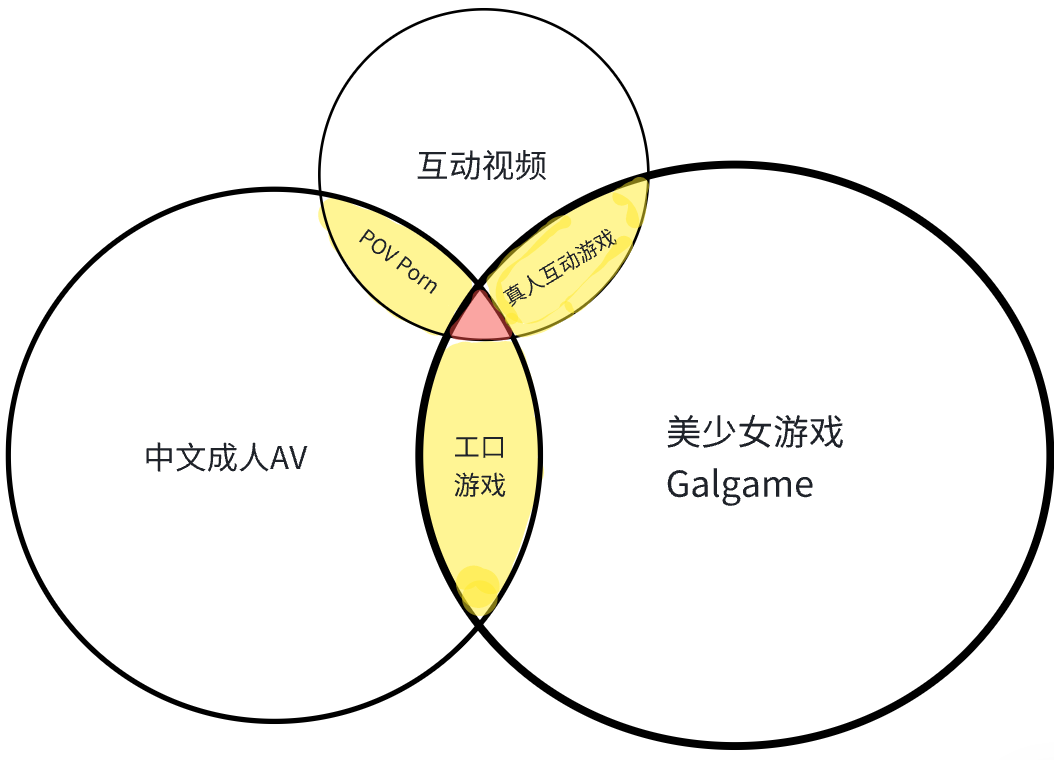
Model Media had spent years building a recognizable brand in Chinese-language adult video. Japanese-origin romance games were expanding internationally, while Chinese versions on Japanese platforms indicated growing attention to Chinese-speaking users. Love Is All Around's broader popularity suggested an intersection of these markets that was still relatively unoccupied.
The three circles in the source diagram are adult games, interactive video and Model Media's Chinese-language adult-video audience. The core audience at their intersection is Chinese-speaking romance-game players who watch adult video and enjoy interactive-video formats.
Opportunity audiences
The source identifies three adjacent groups: adult romance-game enthusiasts whose interests center on fictional characters; live-action interactive-game players who do not watch adult video; and viewers of immersive or point-of-view adult video who have not played adult games.
Recommendations for content and format
First, build around recognizable IP. Japanese adult games increasingly include doujin works, interactive video often adapts web-fiction IP, and film audiences respond to prequels, side stories and alternate universes. Familiar characters can support curiosity about additional stories.
Second, prioritize immersion and emotional payoff. The progression from web novels to short dramas and from long interactive dramas to shorter works shows the importance of identification through story and interaction, with contrast and suspense producing satisfaction. Both games and video need substantive content that meets an emotional need.
Third, start with a fast pace. Short and interactive short dramas gain speed through concise description and brief narrative units. In a fragmented information environment, users want quick, direct access without losing quality or appeal. This does not mean slower formats lack value: they can deepen immersion and loyalty. The initial recommendation is to reach lighter users around the three audience circles first, then develop slower, more detailed experiences for deeply engaged users.
Becoming a platform: variety
Japanese adult-game platforms grew by meeting demand for both variety and transparency. Variety requires enough works and formats, making it difficult for one studio alone to sustain a platform. The source distinguishes vertically oriented services built around major games, such as Blizzard and Epic Games, from horizontal catalogues led by Steam. A small set of large online games can gain variety through updates; a broad catalogue instead depends on new releases from developers it does not directly control. Adult games face different costs and risks from large general-audience online games, helping explain the horizontal model of Japanese adult-game platforms.
As a developer, we can directly control our own content and quality. Early platform operations should therefore focus on making an original game successful, attracting an audience and supplying useful services—a relatively vertical approach. We should then profile those users to understand what else they might enjoy. Given piracy and limited original supply in Chinese-speaking markets, the middle stage should broaden the catalogue through localized Japanese titles, derivative works and higher-quality internal development. This combines original production and licensed distribution, between vertical and horizontal models, with Tencent and NetEase offered as comparisons.
Later, we should reassess. If original work cannot provide enough variety and licensed content barely covers its cost, a combined games-and-video ecosystem may offer structural growth. If original-plus-licensed distribution works, we should progressively establish review mechanisms, reduce publishing barriers and offer development tools to attract more doujin creators.
Becoming a platform: transparency
The source argues that transparency should develop differently at each stage. Initially, internal game quality determines whether users stay. It recommends managing public discussion rather than relying immediately on product reviews, and building trust through other disclosures.
Trust, feedback and participation
At the beginning, we can publish the platform vision, behind-the-scenes development material, payment terms and refund rules. These show that the platform is real and accountable to its users, with reputation as the immediate objective.
As the catalogue grows, we should gradually introduce reviews. They can increase engagement and help a core player community form, while giving developers actionable feedback—especially about licensed or distributed titles.
If the platform evolves into a broader media ecosystem, transparency can follow an open professional-and-user-generated-content model. Profiles for players and creators would make good work and answers traceable and help talented individuals gain exposure.
If the original-plus-licensed game model succeeds, we should deepen direct communication between creators and users, develop the review system further, and let feedback influence merchandising priorities such as featured, popular and discounted games.
Requirements review
I. Requirements plan
Audience | Module | Feature | Phase 1 | Phase 2 | Phase 3 |
Global | Multilingual support | All text supports three languages | √ | ||
Player interface (desktop and mobile) | Account management | Registration and login (including SMS and email providers), personal information and activity history | √ | ||
Game catalogue | Filtering and sorting | √ | |||
Game details | Likes, favorites and comments | √ | |||
Top-up flow | Top-up history | √ | |||
Purchase flow | Purchase history | √ | |||
Marketing features | Event triggers | √ | |||
Creator interface | Game management | Version history; listing and unlisting | √ | ||
Data management | Game analytics | √ | |||
Income and withdrawals | Income history, withdrawal history and withdrawal requests | √ | |||
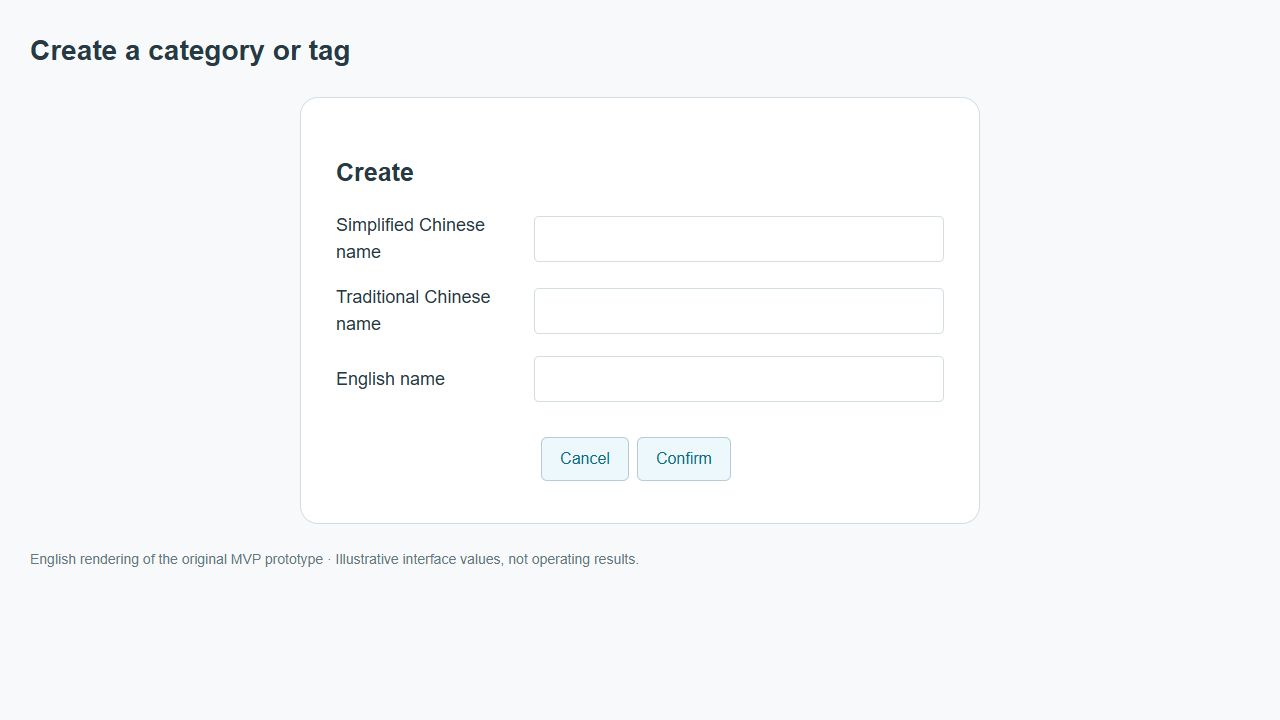
Platform administration | Classification management | Category and tag management | √ | ||
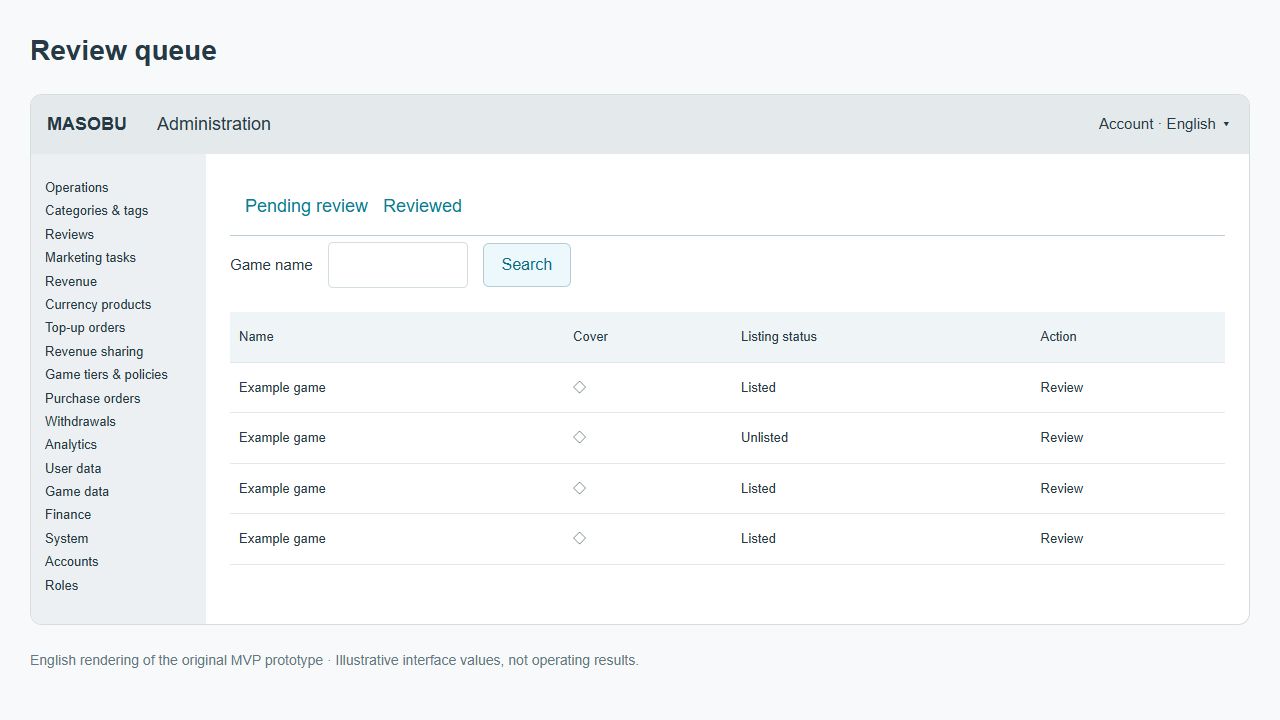
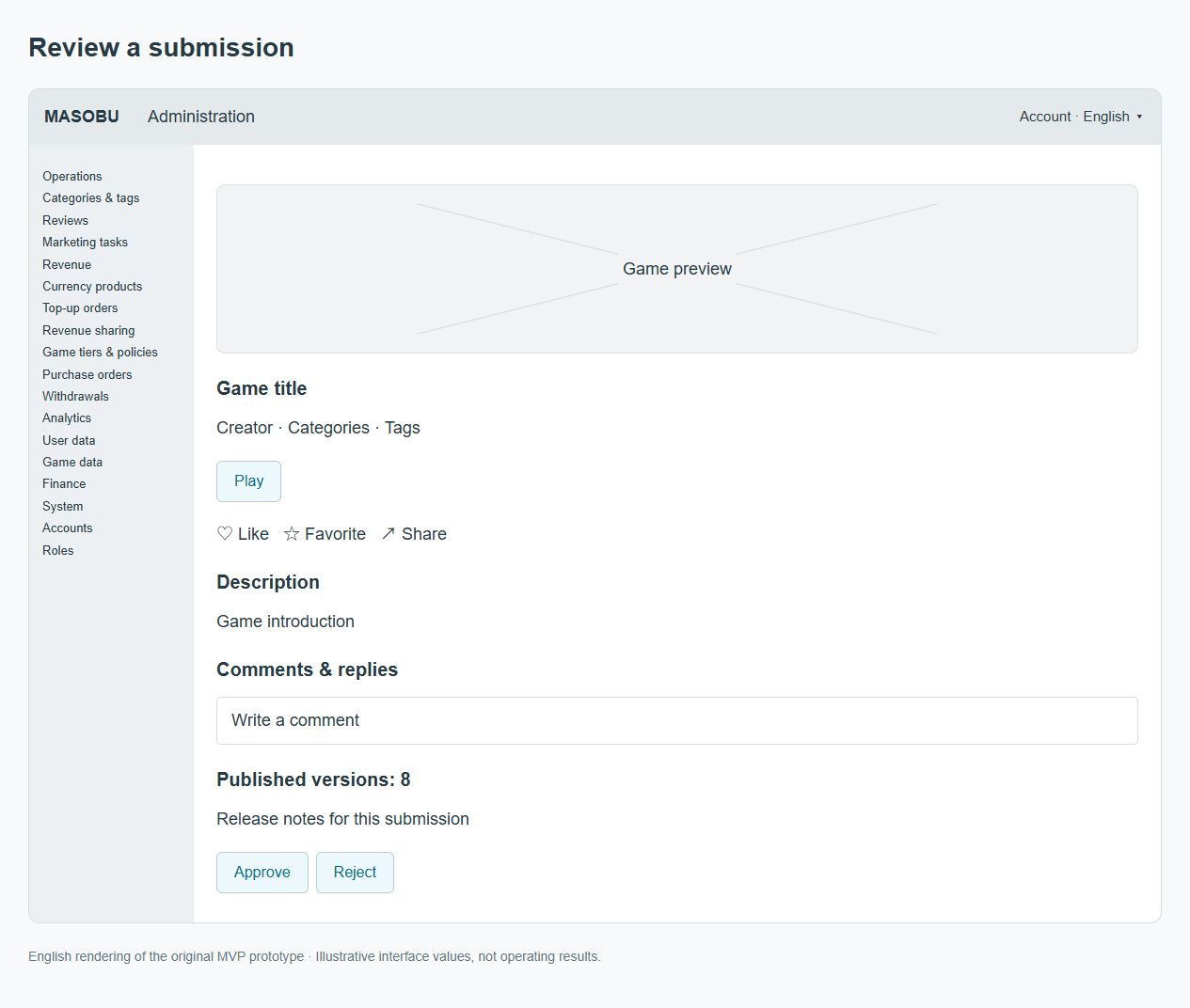
Review management | Review history, submission previews and review actions | √ | |||
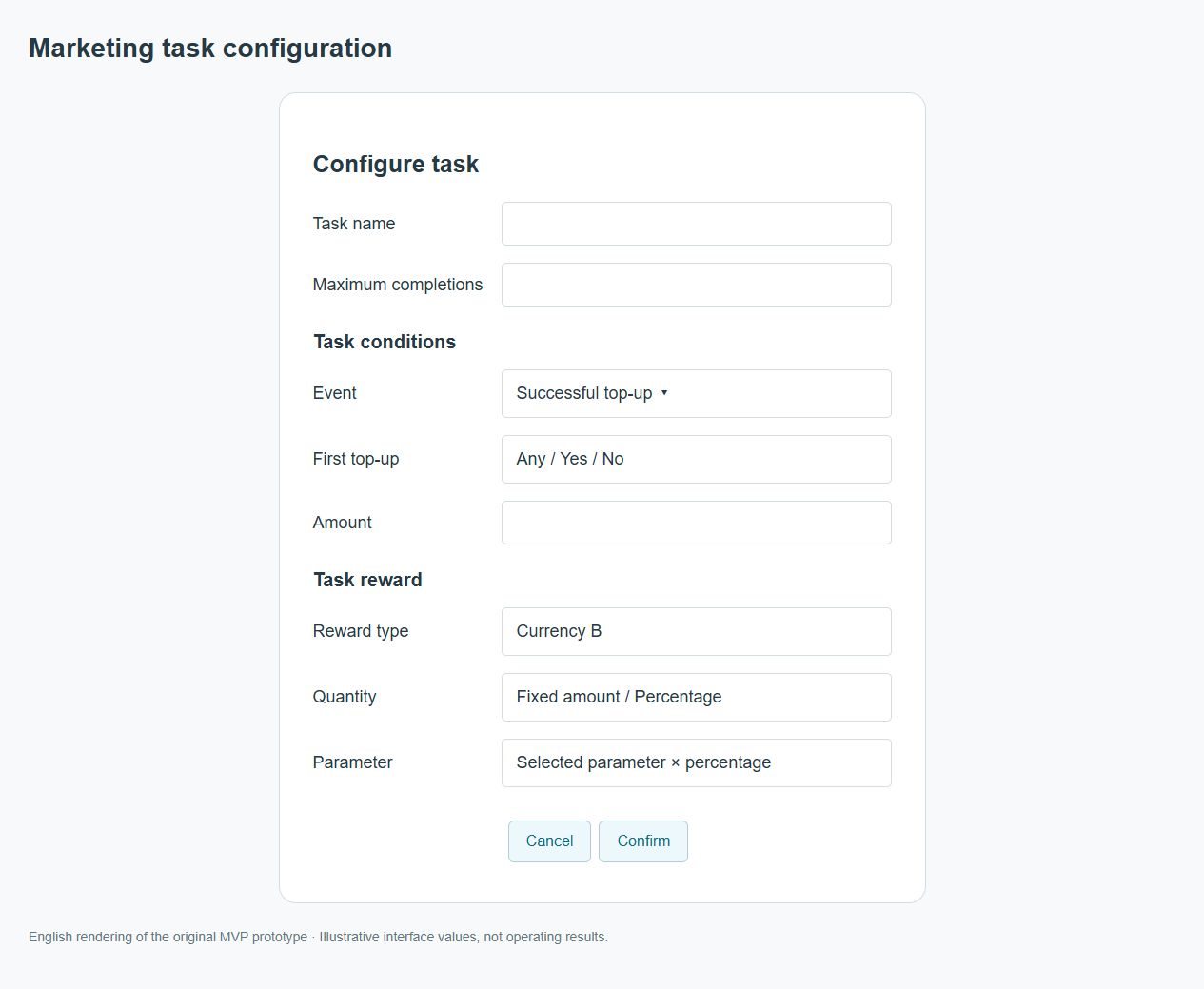
Marketing management | Referral relationships and task management | √ | |||
Revenue management | Product and order management | √ | |||
Revenue sharing | Revenue-share records and withdrawal processing | √ | |||
Analytics | User and game analytics | √ | |||
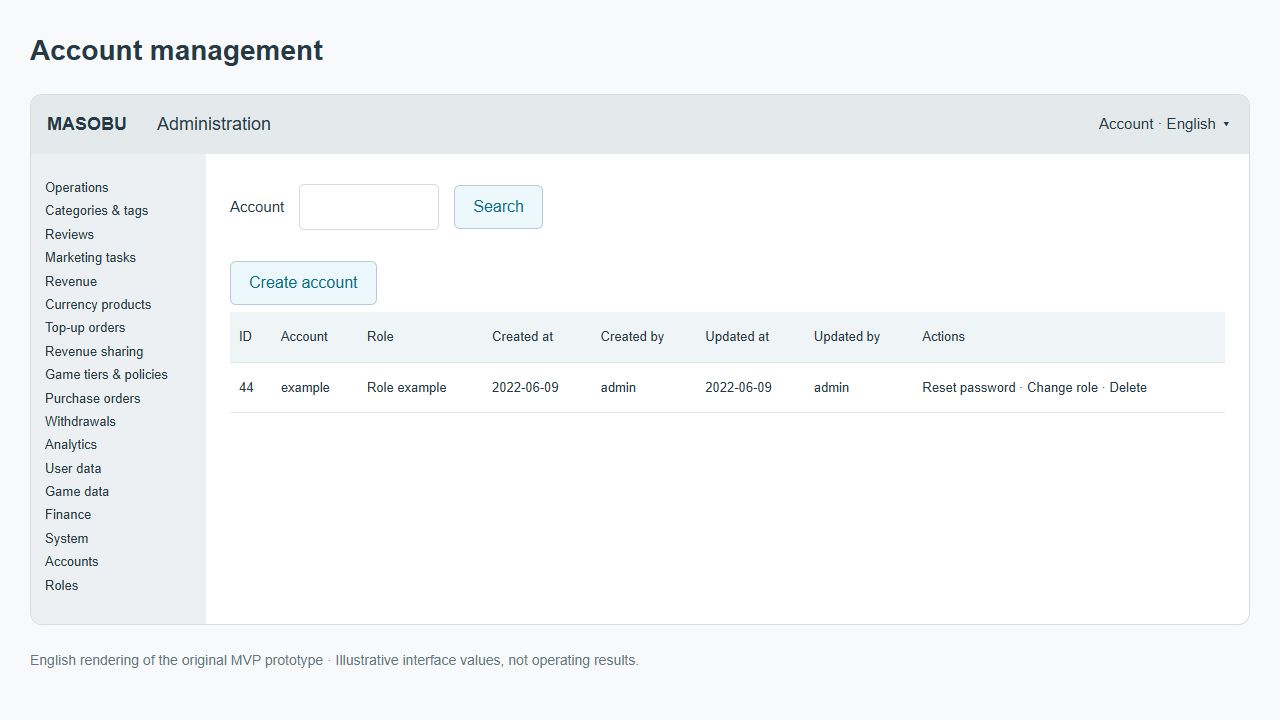
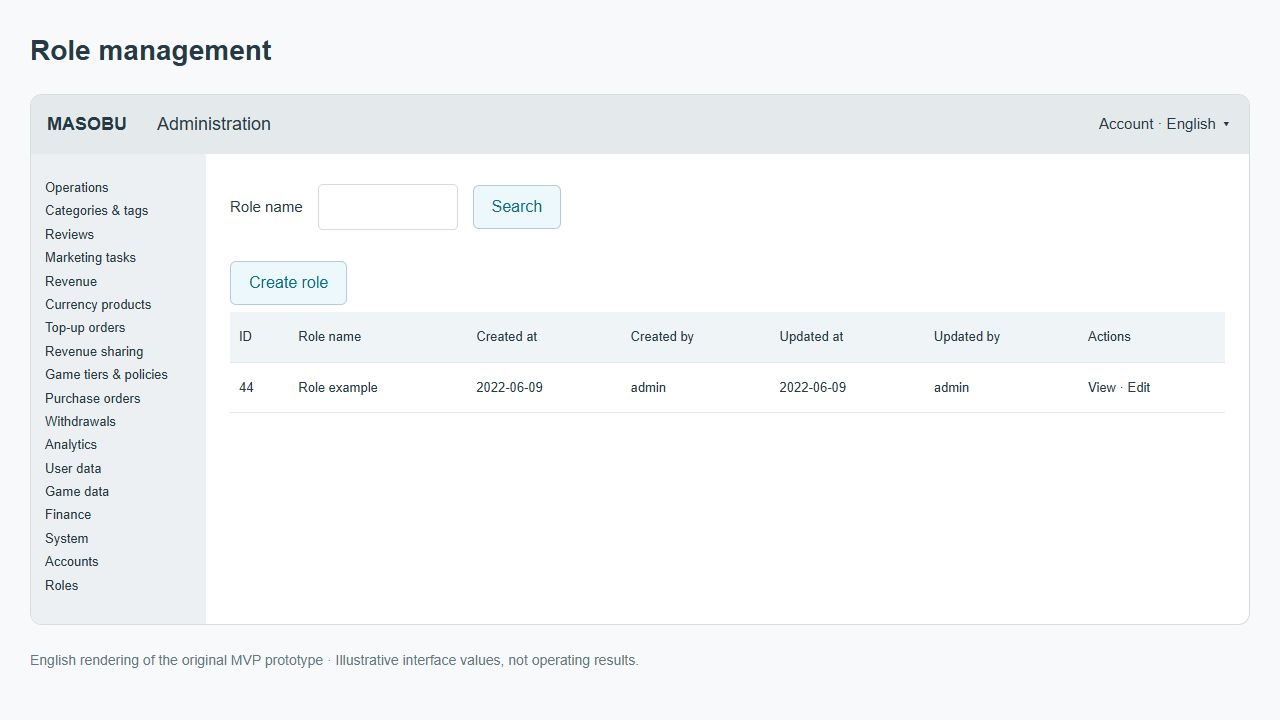
System administration | Account and permission management | √ |
II. Requirements specification
1. Global requirements
1.1 Supported devices
Audience | Supported interfaces |
Player interface | Desktop web; Mobile web: whether playing games is supported remains to be confirmed (Yiciyuan only supports viewing details); App: Android supported |
Creator interface | Desktop web |
Platform interface (administration console) | Desktop web |
1.2 Multilingual support
Audience | Languages |
Player interface | Switch between Simplified Chinese, Traditional Chinese and English |
Creator interface | Switch between Simplified Chinese, Traditional Chinese and English |
Platform interface (administration console) | Switch between Simplified Chinese, Traditional Chinese and English |
1.2.1 Scope
Description | |
System features | Fixed copy: strings defined in code |
Configurable copy: classification management | |
Game content | Creator-generated content: multilingual support remains to be confirmed (basic information is supported) |
Reference platforms:
Platform | Description |
Nutaku [spelled “nutatu” in the source] | System features support language switching; game content does not |
Yiciyuan | No interface language switch. Creators choose a language when creating a game: Simplified Chinese titles appear only in mainland China; Traditional Chinese titles appear only in Hong Kong, Macao and Taiwan. |
1.2.2 Implementation options
Description | Advantages | Disadvantages | Assessment | |
Custom translations supported | Define all three language versions and return them together to the frontend | More accurate translations | Applying this everywhere creates a large scope; adding a language requires more work | Suitable for classification management, where category and tag wording may need particular precision |
Custom translations not supported (Not being implemented) | Send the current copy to a translation API for the requested language | Centralized handling; more general-purpose | Some translations may be inaccurate | Could be used for fixed system copy such as menus and messages |
2. Account management
2.1 Player / creator interfaces
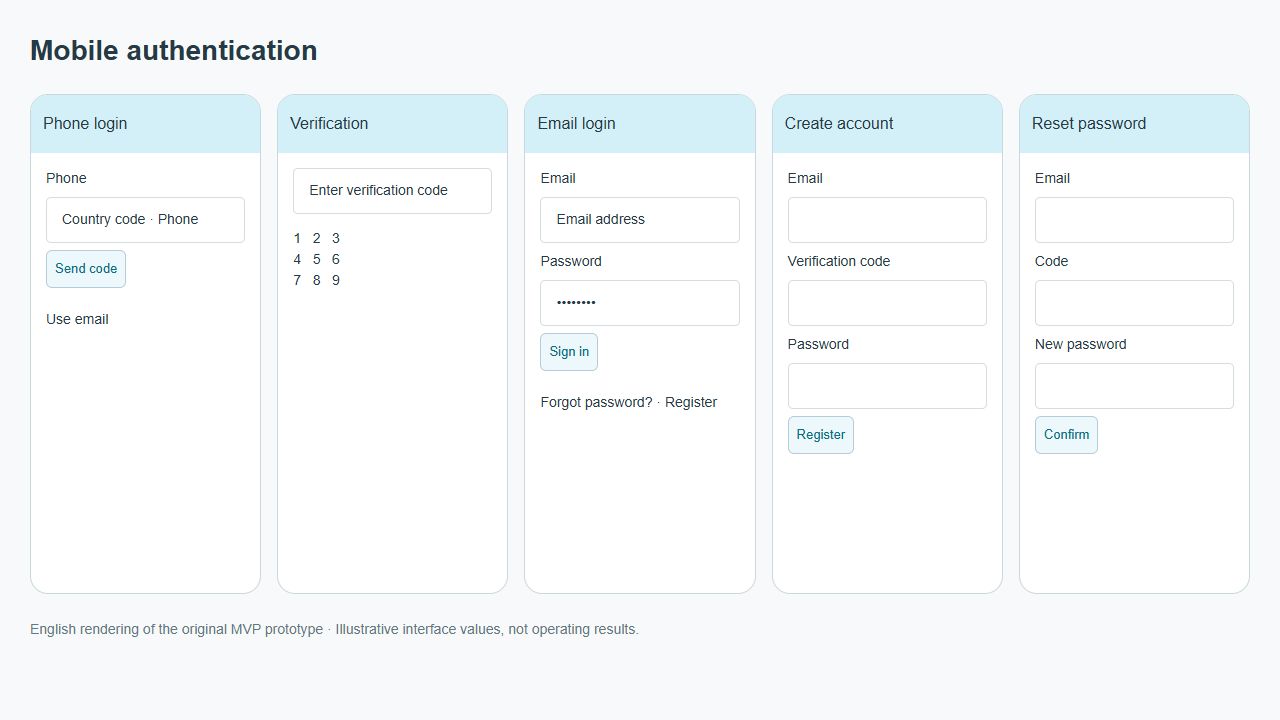
Registration / login method | Description |
Email + password | Verify the email address using a verification code |
Phone number + verification code | Supported country codes remain to be confirmed |
After registering with email and password, users may verify and link a phone number in their profile, then sign in with that number and a verification code.
After registering with a phone number and verification code, users may verify and link an email address and set a password in their profile.
Forgotten password: recover through email
2.2 Platform administration
Module | Description |
Login method | Username and password |
Account creation | Developers seed the super-administrator credentials in the database; this role has all permissions. The super-administrator can create accounts and assign the appropriate role permissions. |
Permission management | Configure the menu permissions assigned to each role |
3. Game classification and sorting
3.1 Classification management
Description | |
Category management | Relatively stable categories; a game can have multiple categories |
Tag management | More flexible and numerous; a game can have multiple tags |
Actions by audience:
Audience | Description |
Platform administration | Manage categories and tags |
Creator interface | Assign categories and tags to games |
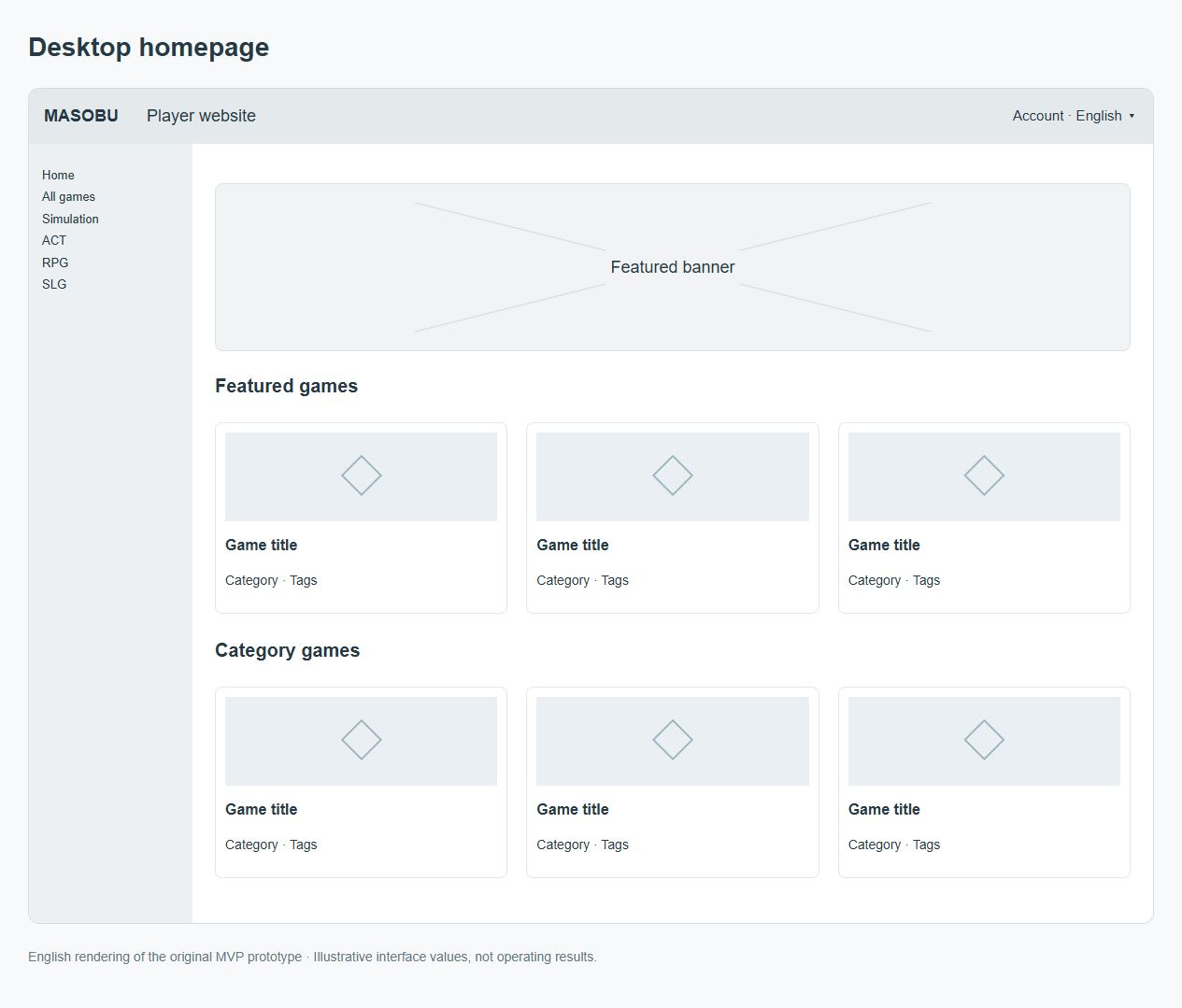
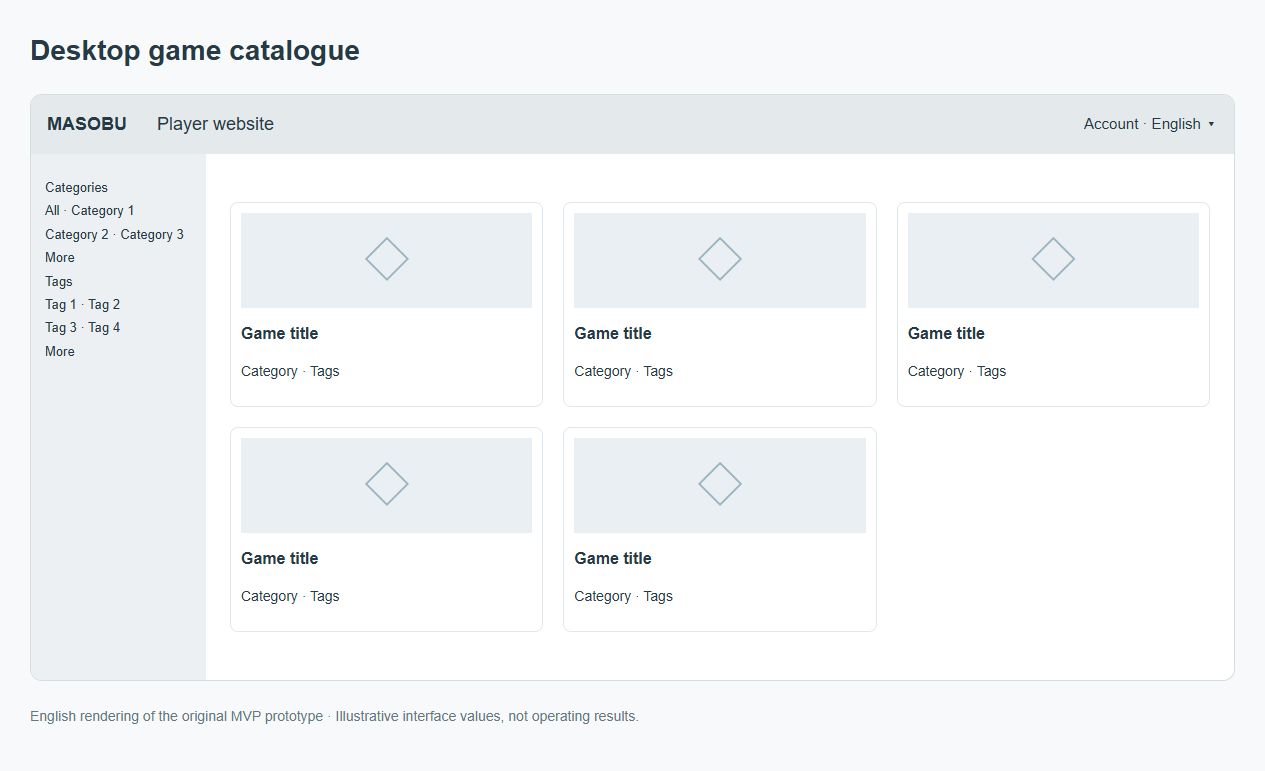
Player interface | Filter games by categories and tags |
3.2 Sorting rules
Will Phase 1 allow players to customize sorting? To be decided.
Description | |
Composite ranking | Example: plays × 0.5 + favorites × 0.3 + likes × 0.2 |
Specific metric | For example, plays, favorites or likes |
Last updated | More recently updated games appear first |
4. Game management (online games)
4.1 Game versions
1) Version records
Each game has multiple version records. After a publication request, subsequent edits and saves must create a new version record.
Publication status for each version:
Status | Description |
Draft | Saved but not submitted for publication |
In review | Submitted for publication |
Rejected | The reviewer has rejected the version |
Approved | The reviewer has approved the version |
Published | Release trigger: supports scheduled or immediate publication |
Will Phase 1 support version rollback? To be confirmed.
2) Retrieval scenarios
Scenario | Description |
Player gameplay (live) | Retrieve the latest version with Published status |
Creator testing | Retrieve the latest version regardless of its status |
Review preview | Retrieve the exact version associated with the review record |
4.2 Game review
1) Submission requirements
Check eligibility, such as word count (to be decided).
A game cannot submit the same version for publication more than once.
A new publication request cannot be submitted while another is in review; withdrawal is supported.
2) Review process
Phase 1 supports human review only.
Rejection reasons are entered freely by the reviewer.
4.3 Listing status
Type | Description |
Action | Only games with at least one Published version may be listed. Restrictions on unlisting games: to be decided. |
Retrieval | All player-facing game queries return listed games only. |
4.4 Android games
Creators upload a game package directly. Provide an SDK with registration/login, top-up and purchase components to integrate into an Android APK.
5. Interaction
Phase 1 | Description | |
Like | √ | Not liked: the user can like the game; Already liked: the user can remove the like. |
Favorite | √ | Not favorited: the user can add a favorite; Already favorited: the user can remove the favorite. |
Comment | √ | Comments and replies are supported. Should inappropriate language be filtered? Can the comment author or game creator delete comments? |
Share | √ | Copying a link is supported |
Follow | ||
Tip |
6. Paid features
6.1 Virtual-currency account (player)
Currency definitions:
Virtual currency | Acquisition | Use |
Currency A | Obtained through paid top-ups | Used to buy games |
Currency B | Obtained through rewards | Offsets Currency A; the platform sets the conversion ratio and cap |
Changes to the Currency A balance:
Operation | Trigger | Scenario |
Increase | Successful top-up | Credit the corresponding currency after successful payment of a top-up order |
Failed purchase | Return the currency after a purchase order fails | |
Decrease | Top-up refund | Deduct the corresponding currency after a top-up refund (to be confirmed) |
Successful purchase | Purchase of access rights |
Update the user's virtual-account balance after a successful operation.
6.1.1 Top-ups
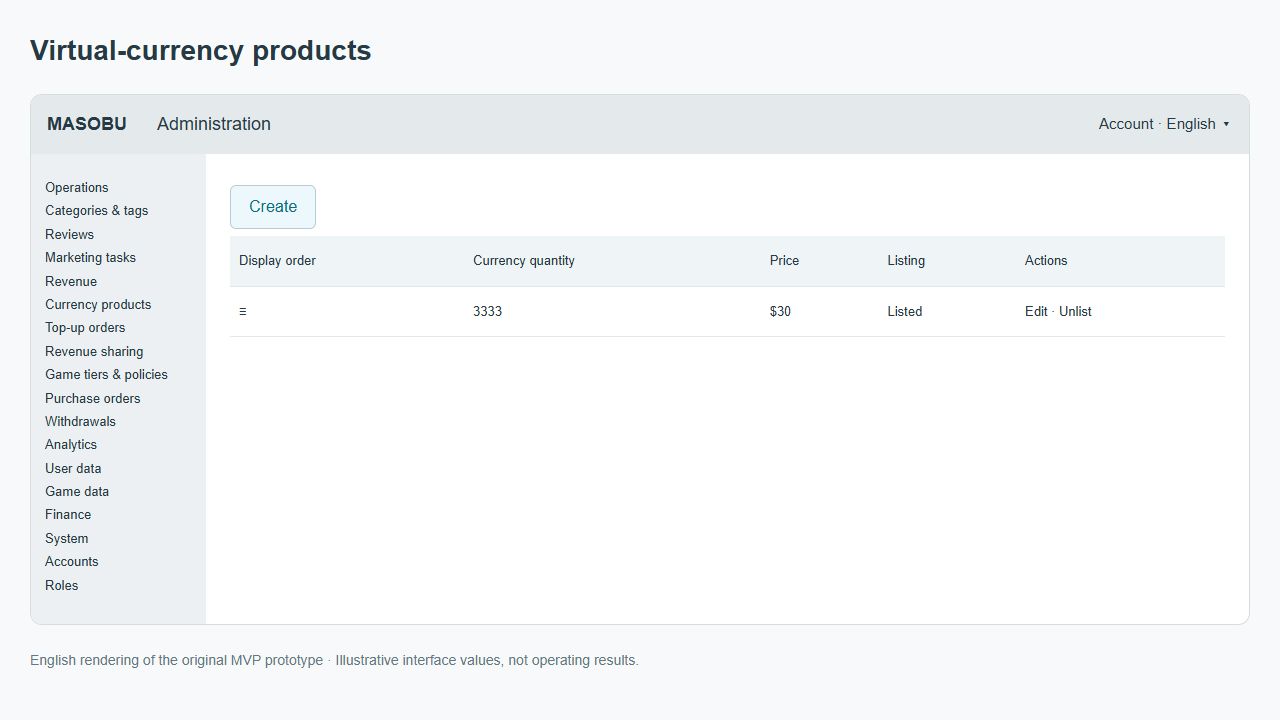
1) Currency A product management
Parameter | Description |
Currency quantity | The quantity of currency received after successful payment |
Strikethrough currency quantity | If provided, show it struck through and indicate the additional bonus currency |
Price | Currency: US dollars |
Product image | Displayed in the frontend |
Purchase restrictions | For example, first purchase only |
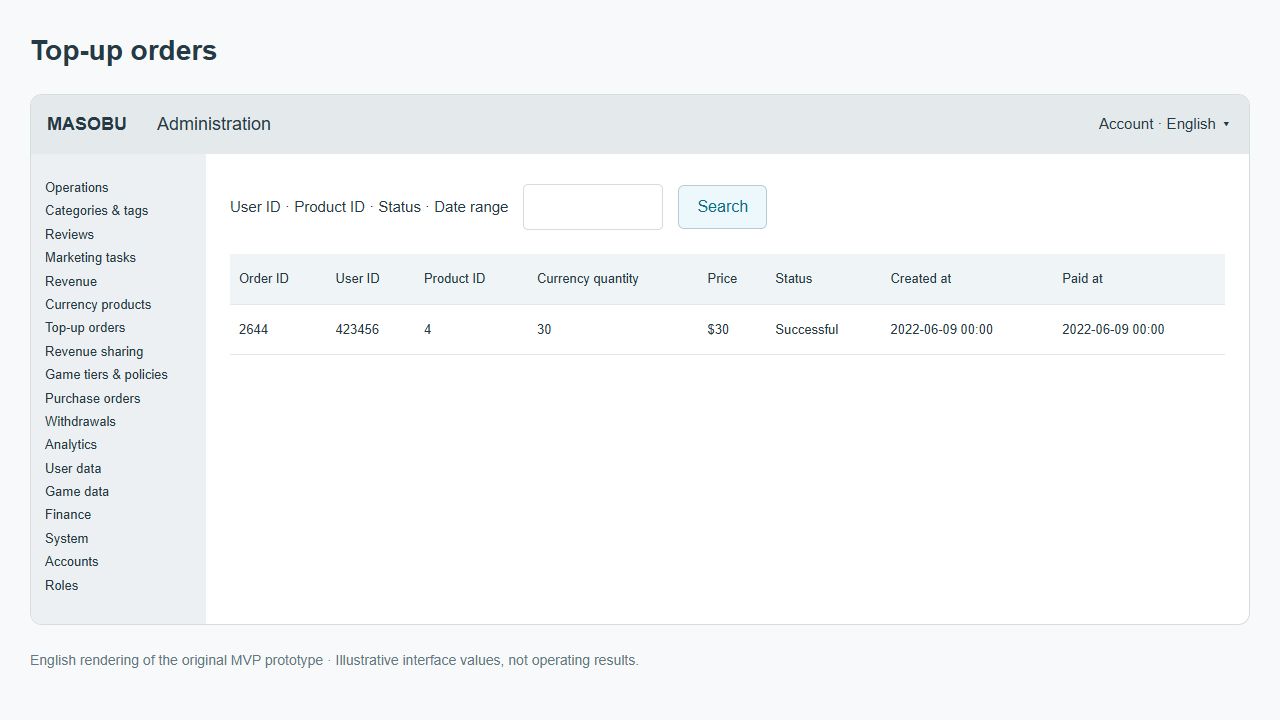
6.2.2 Top-up order management
Parameter | Description |
Currency quantity | The quantity of currency received after successful payment |
Payment amount | Actual amount paid |
Payment method | / |
Order status | Awaiting payment, payment cancelled, payment successful, payment failed, refunded (whether refunds are supported is open) |
6.2.3 Payment methods (integrate with the supplied payment API)
Payment methods supported by Nutaku:
Payment-method reference
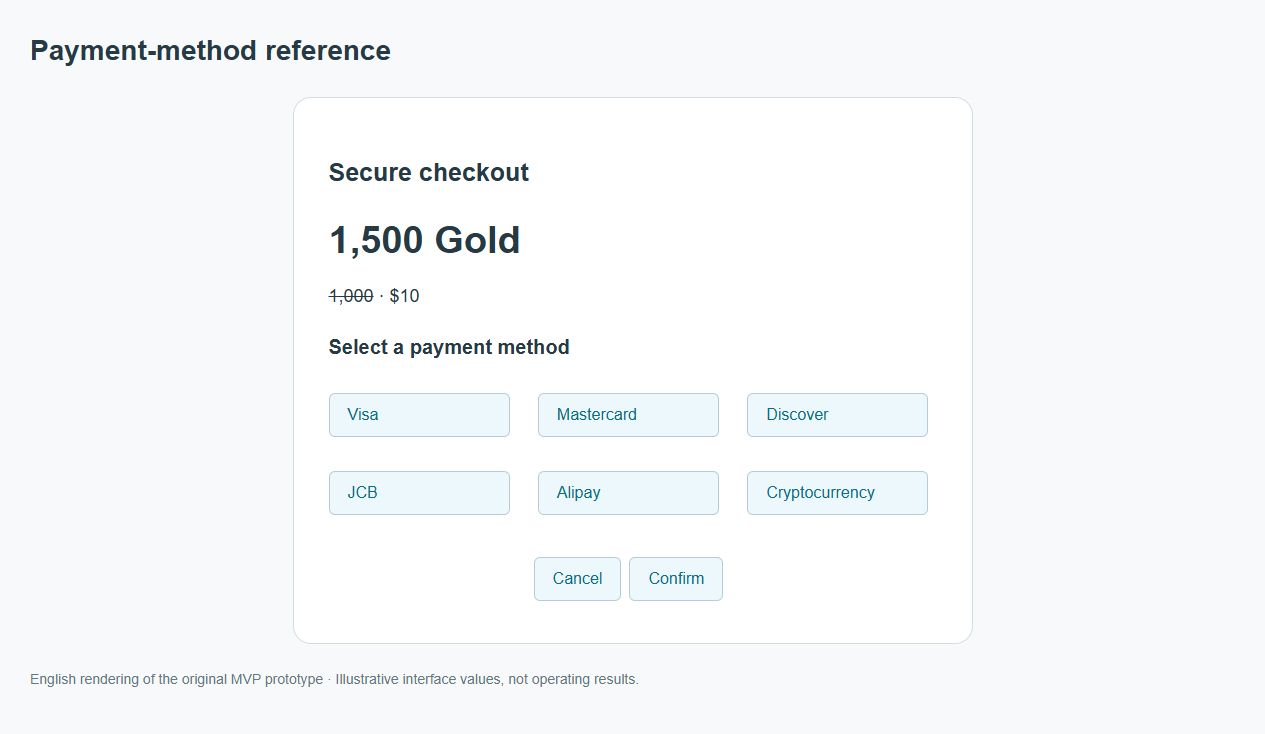
Type | Description |
Card networks | Visa and others |
Third-party payment | PayPal; Alipay |
6.1.2 Purchases
Own the purchase-order functionality, not management of the purchased products or the service that unlocks access after purchase.
6.2 Revenue-share account (creator)
Operation | Trigger | Scenario |
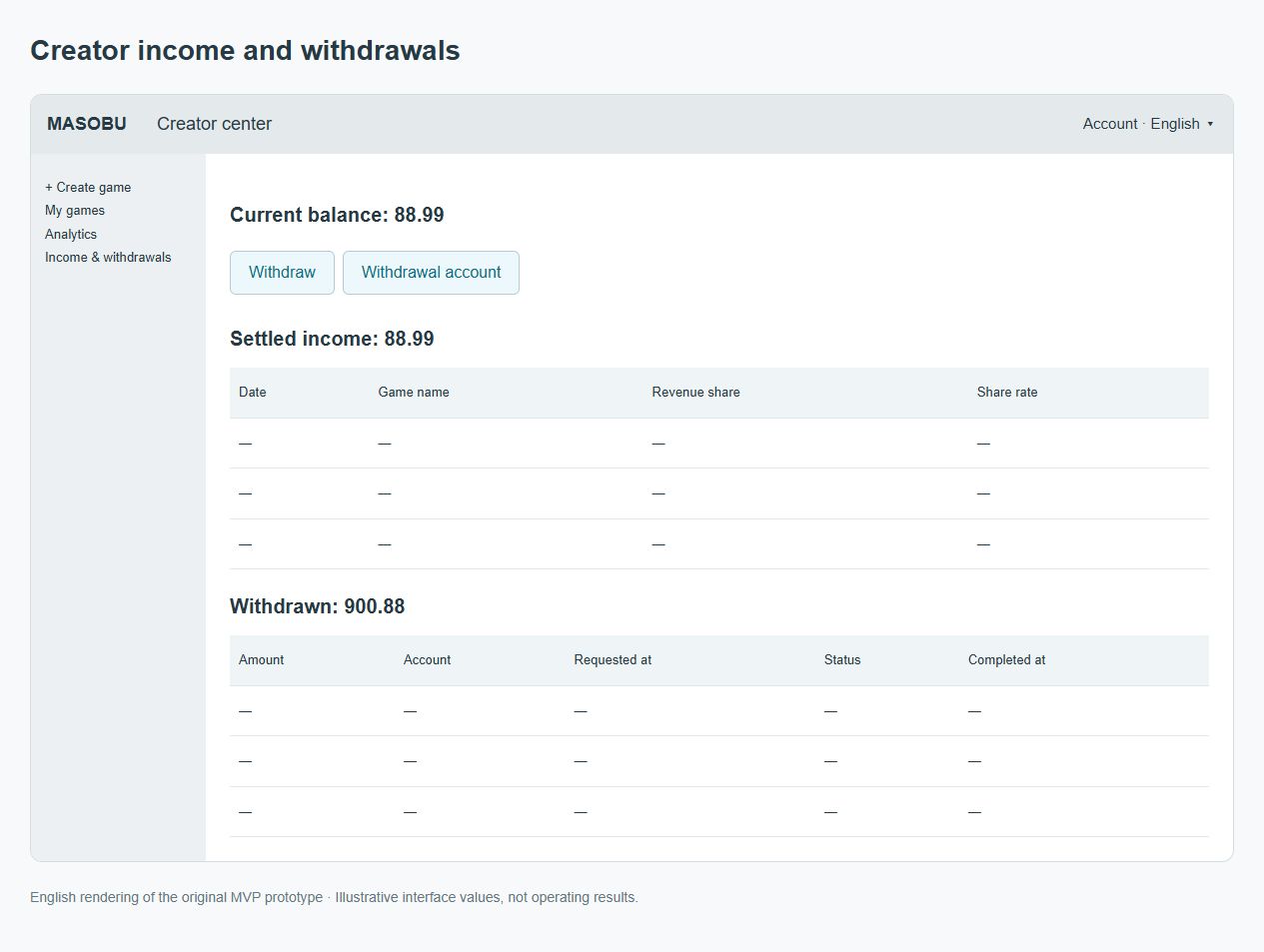
Increase | Settlement on the first of each month | Settle the previous month's accrued income into the user's account balance |
Decrease | Successful withdrawal | Deduct the withdrawal amount when its status changes to Successful |
6.2.1 Revenue sharing
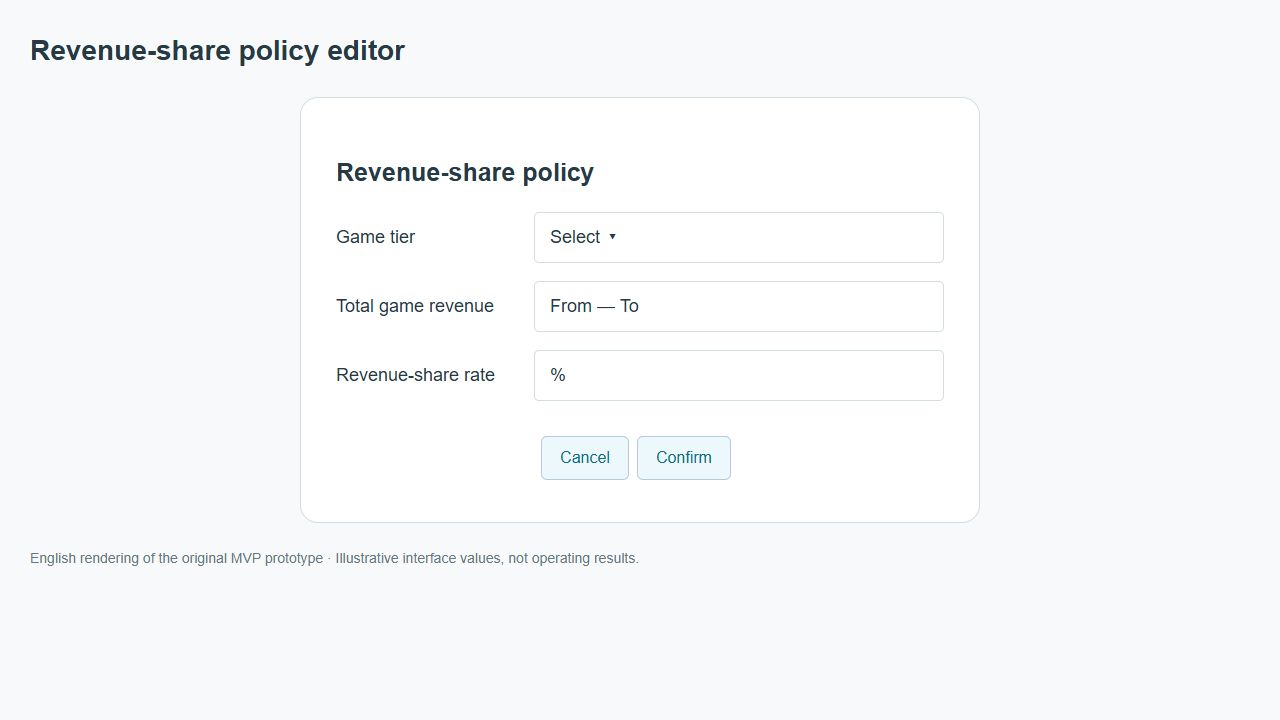
1) Revenue-share configuration
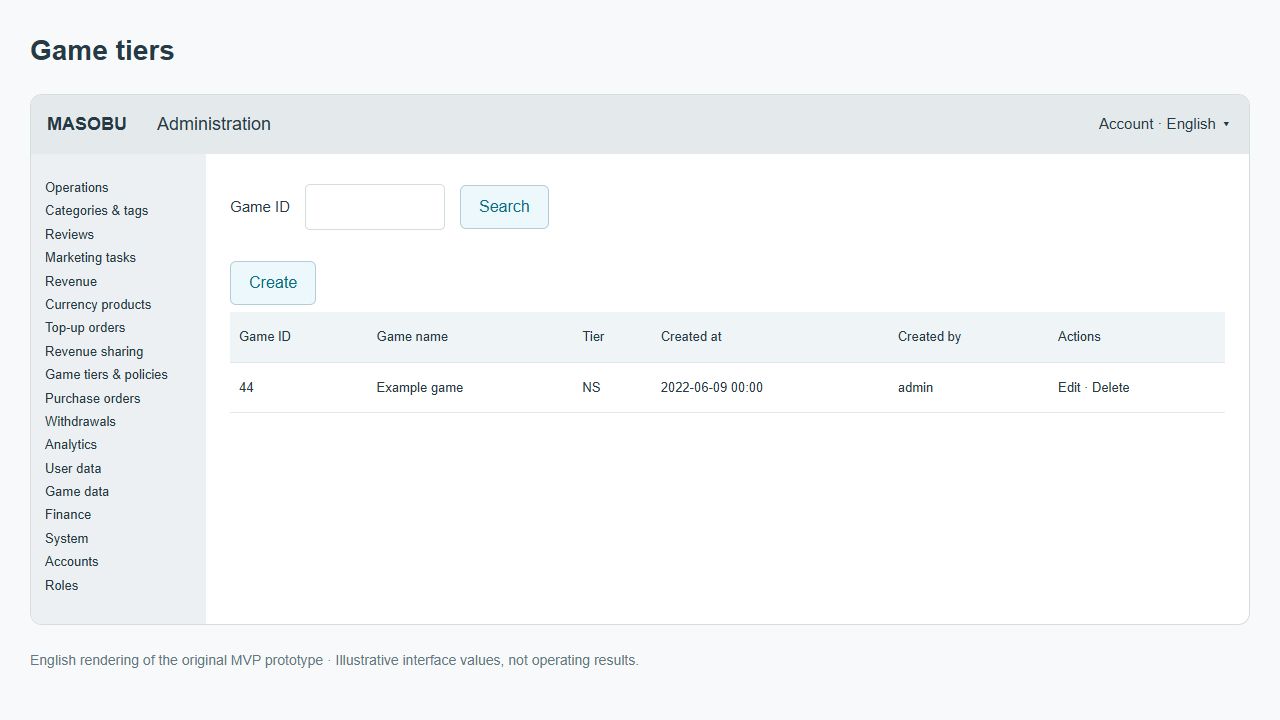
The administration console can assign a game tier by game ID.
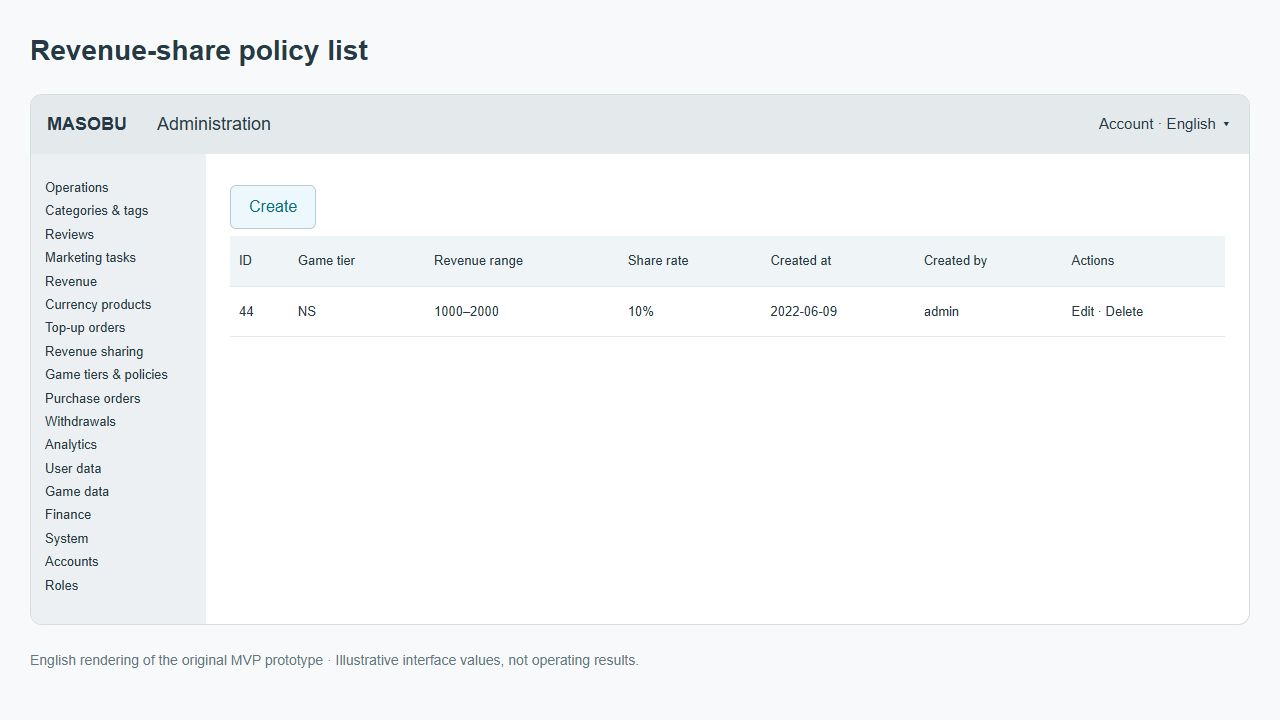
Configure revenue-share policies by game tier, with percentage rates linked to gross-revenue thresholds.
At monthly settlement, should revenue below and above a threshold use different rates?
Is Currency B excluded from revenue sharing?
The platform's standard onboarding agreement must be signed.
2) Revenue-share records
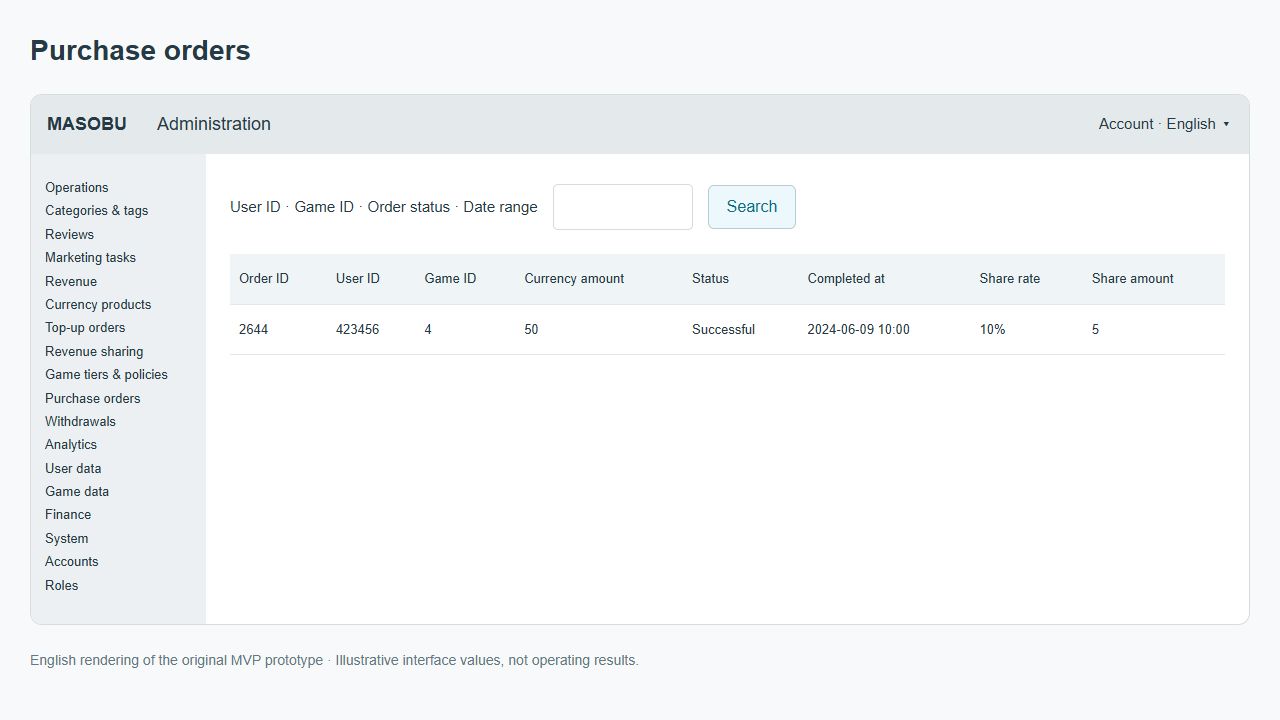
After a successful purchase, check whether revenue sharing applies; if it does, create the corresponding creator's revenue-share record.
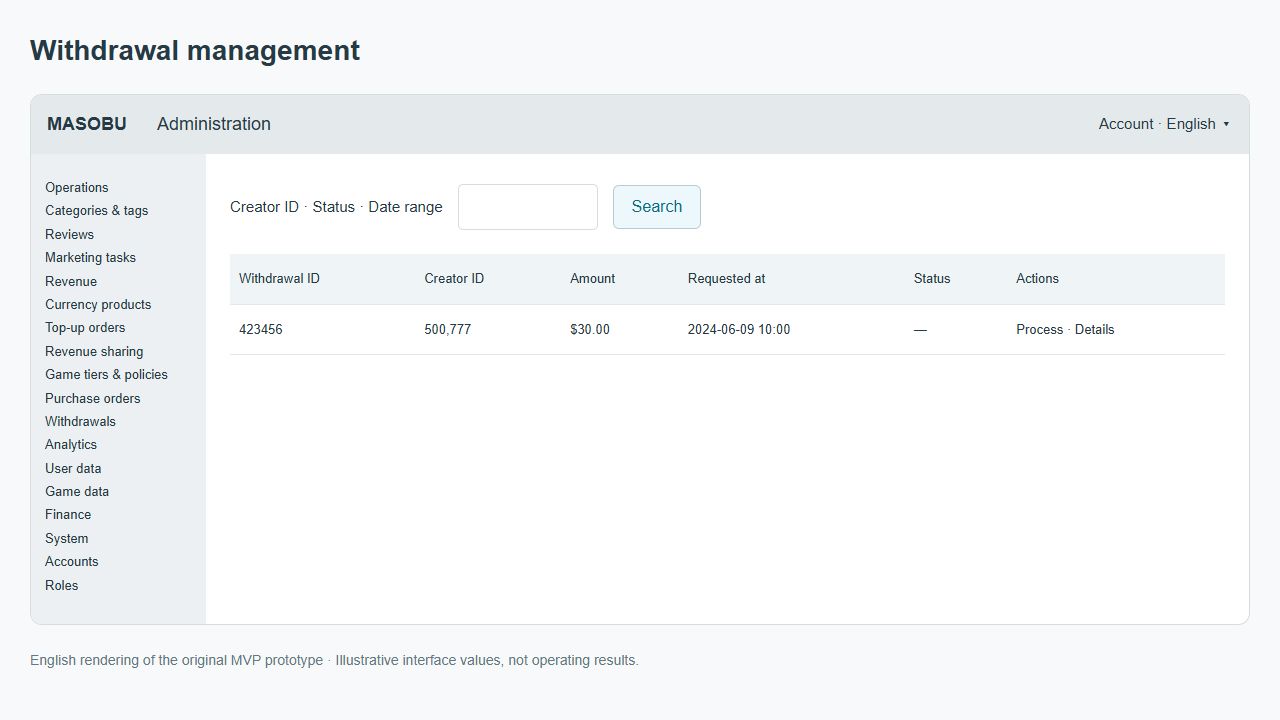
6.2.3 Withdrawals
Custom withdrawal amount, subject to a minimum greater than USD X
Withdrawal method: offline transfer; creators enter their bank account details
Should the withdrawal account be a Tipalti account? To be decided.
7. Marketing management
7.1 Referral relationships
A registration invitation link must include the inviter's user ID. Successful registration links the invited user with the inviter.
7.2 Task management
Events trigger the relevant tasks; rewards are issued when their conditions are met.
1) Events
Support the following events:
Event | Description |
Invite a registration | An invited user registers and a referral relationship is established |
Invite a top-up | A linked invited user makes a top-up |
Successful top-up | Configure whether it must be the first top-up and the required amount |
Convert account balance to Currency A | Configure the conversion amount |
2) Rewards
Issue Currency B as either an absolute amount or a percentage of another parameter, such as a percentage of Currency A obtained by converting an account balance.
8. Analytics
8.1 Creator analytics
1) Game analytics
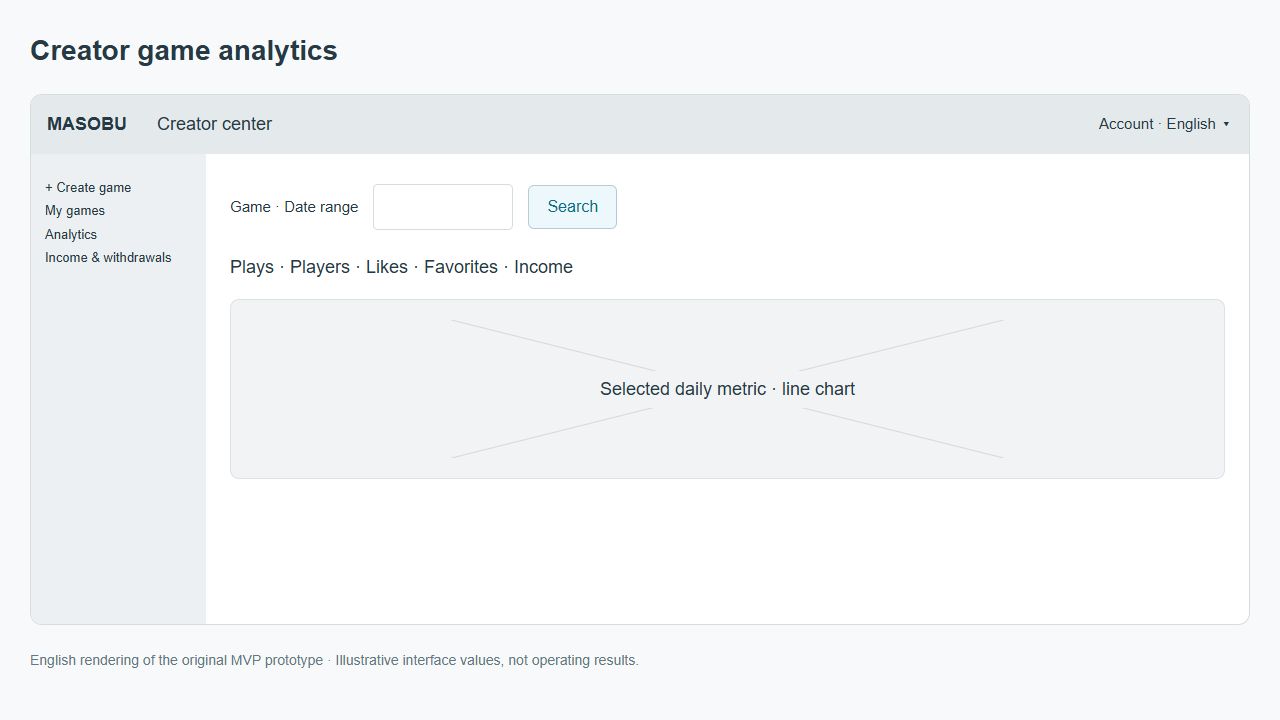
View these daily metrics for a selected game over a selected period:
Metric | Definition |
Plays | Total times the game is played |
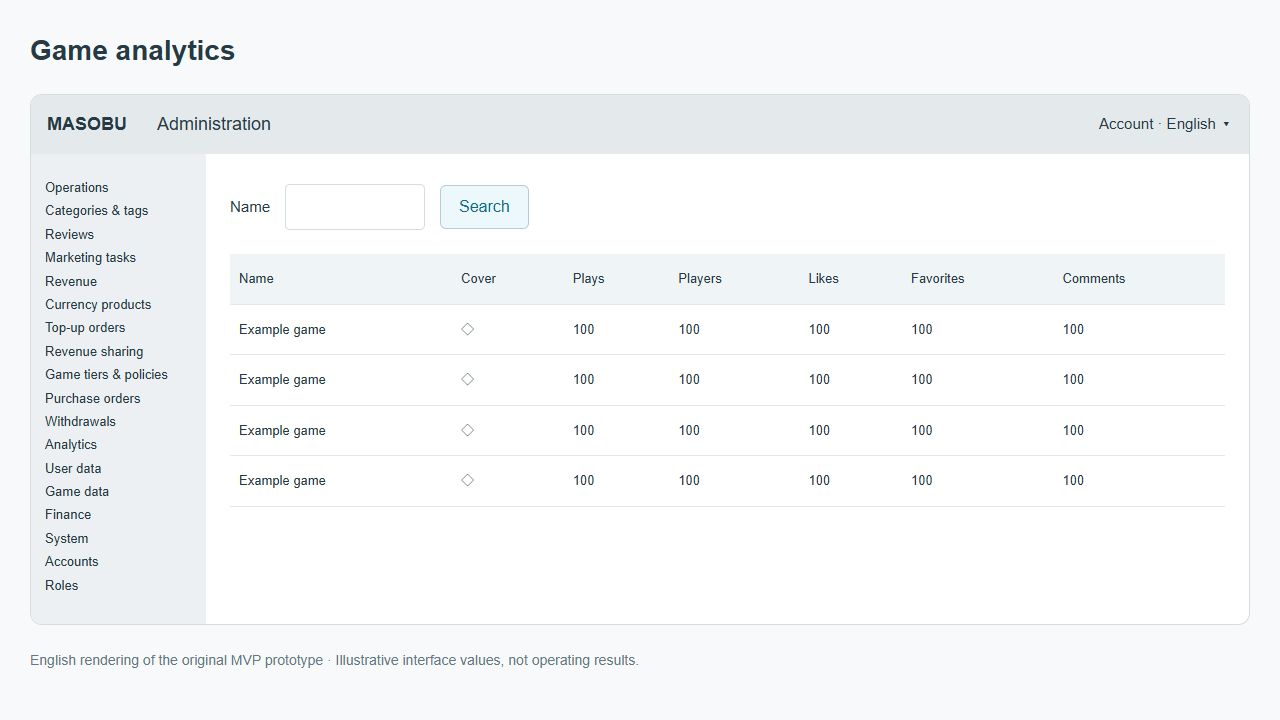
Players | Number of users who play the game |
Likes | Number of users who like the game |
Favorites | Number of users who favorite the game |
Income | Total revenue-share income from this game per day |
Supported range: 30 days, displayed as a line chart; avoid an excessively long range.
Cold-start data
2) Income and withdrawals
Income: total income per day
Withdrawals: display withdrawal records
8.2 Platform analytics
Type | Metric | Definition |
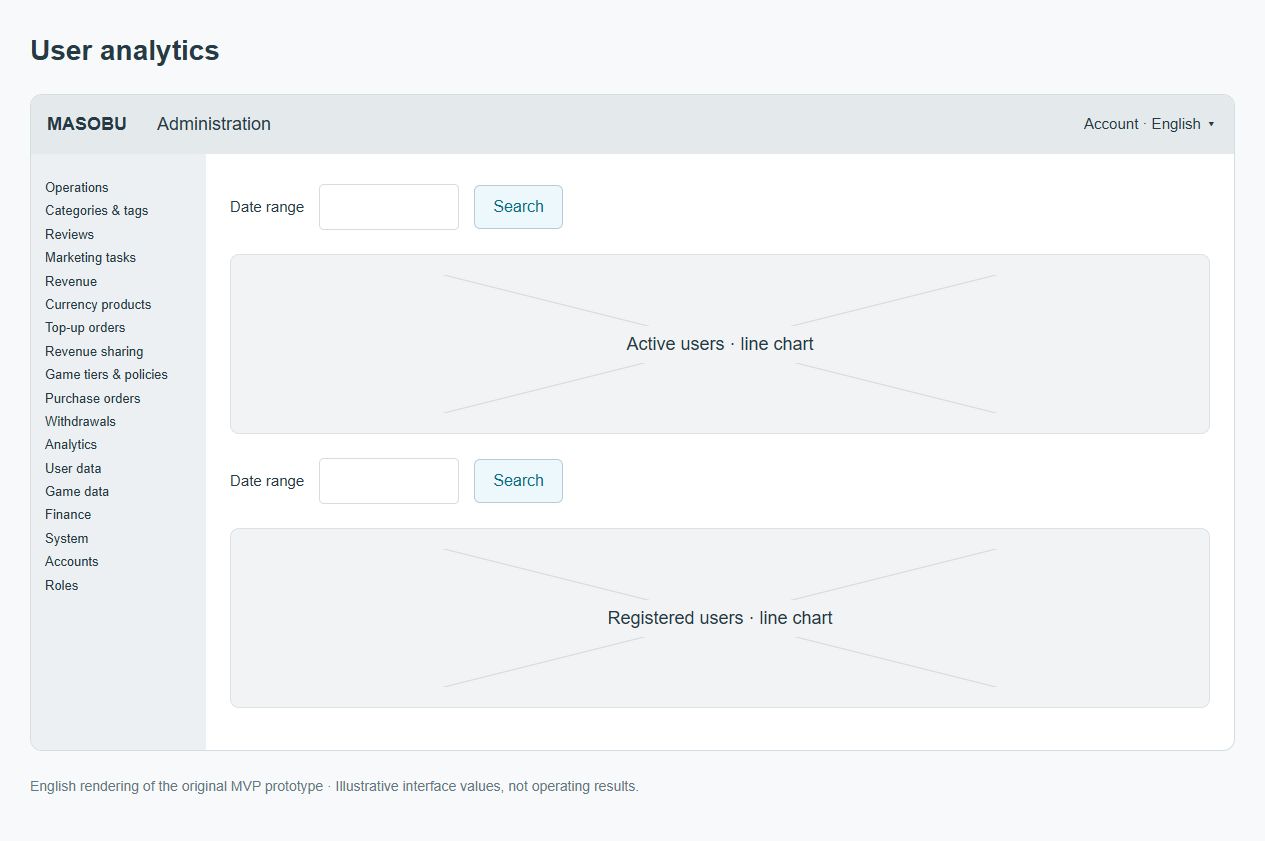
User data (supports a 30-day range) Different time dimensions | Registered users | Number of users registered each day |
Active users | Total registered or logged-in users each day | |
Game data | Plays | Total times the game is played |
Players | Total number of users who play the game | |
Likes | Total number of users who like the game | |
Favorites | Total number of users who favorite the game | |
Comments | Total comments on the game | |
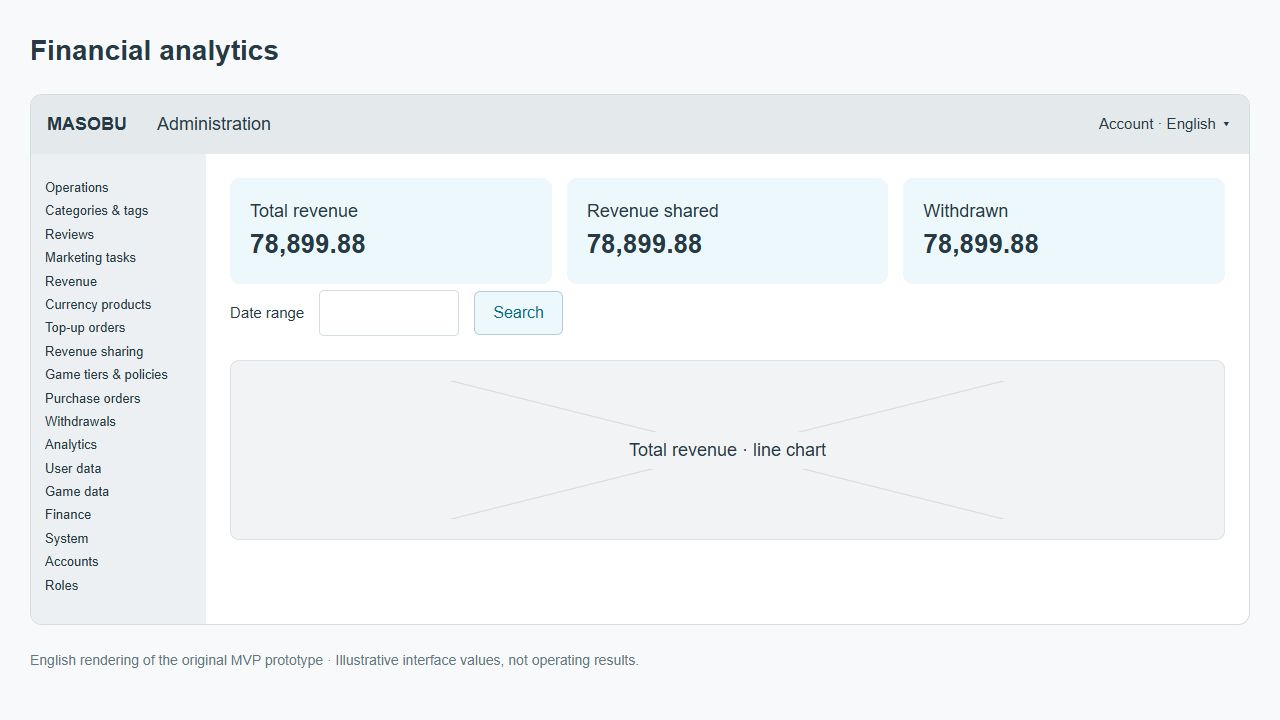
Financial data | Total revenue | Sum of all successfully paid orders |
Revenue shared | Sum of all revenue-share records | |
Withdrawn | Sum of all successful withdrawal records |
9. Editor-related interfaces
Feature | Description |
Edit game information | Open the editing page in a new window |
Test | Open a new window and play fullscreen using the latest game data |
Publish | Check that publication requirements are met; Require release notes |
Save | Save the game data |
III. Prototype interfaces
1. Player interface (desktop)
1.1 Game pages
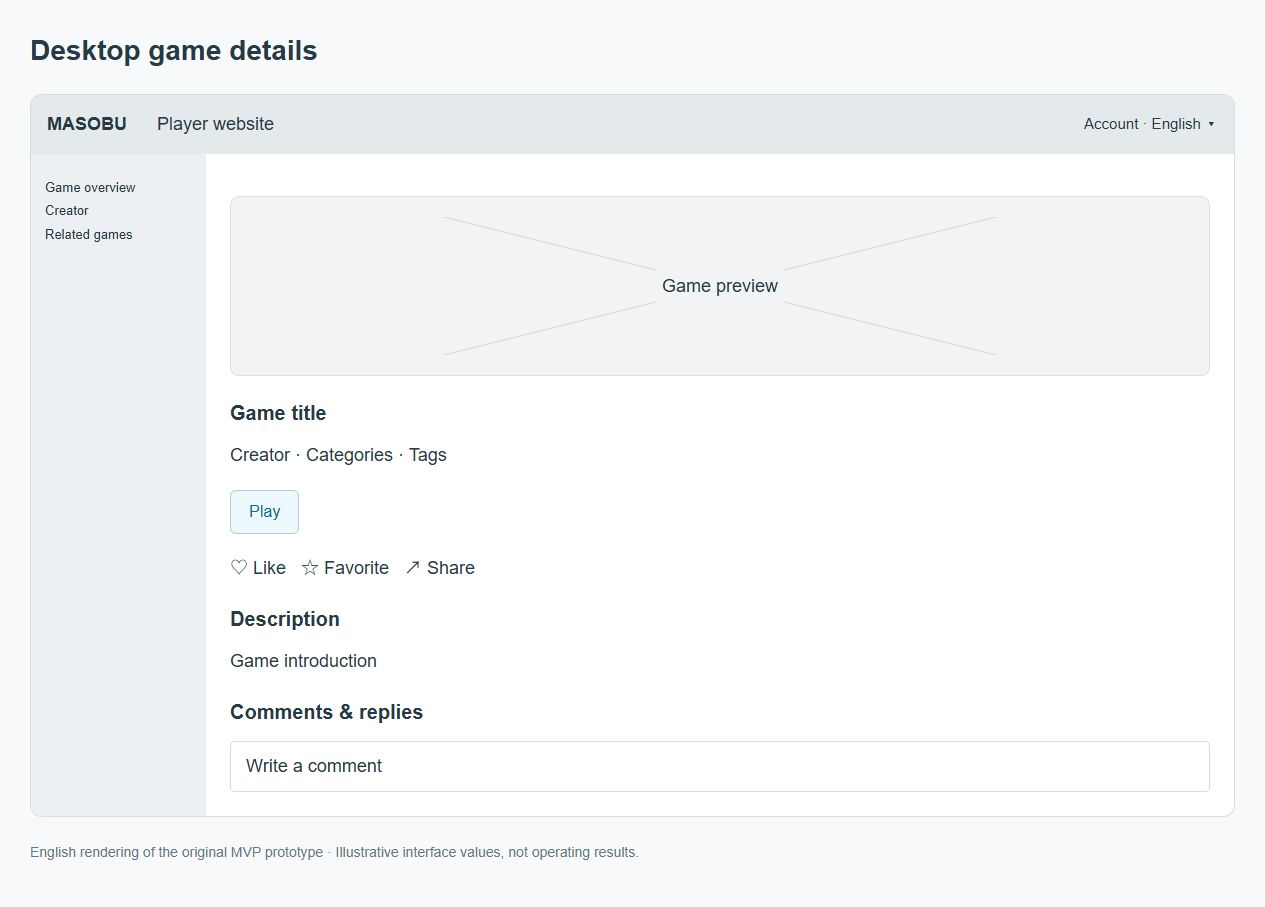
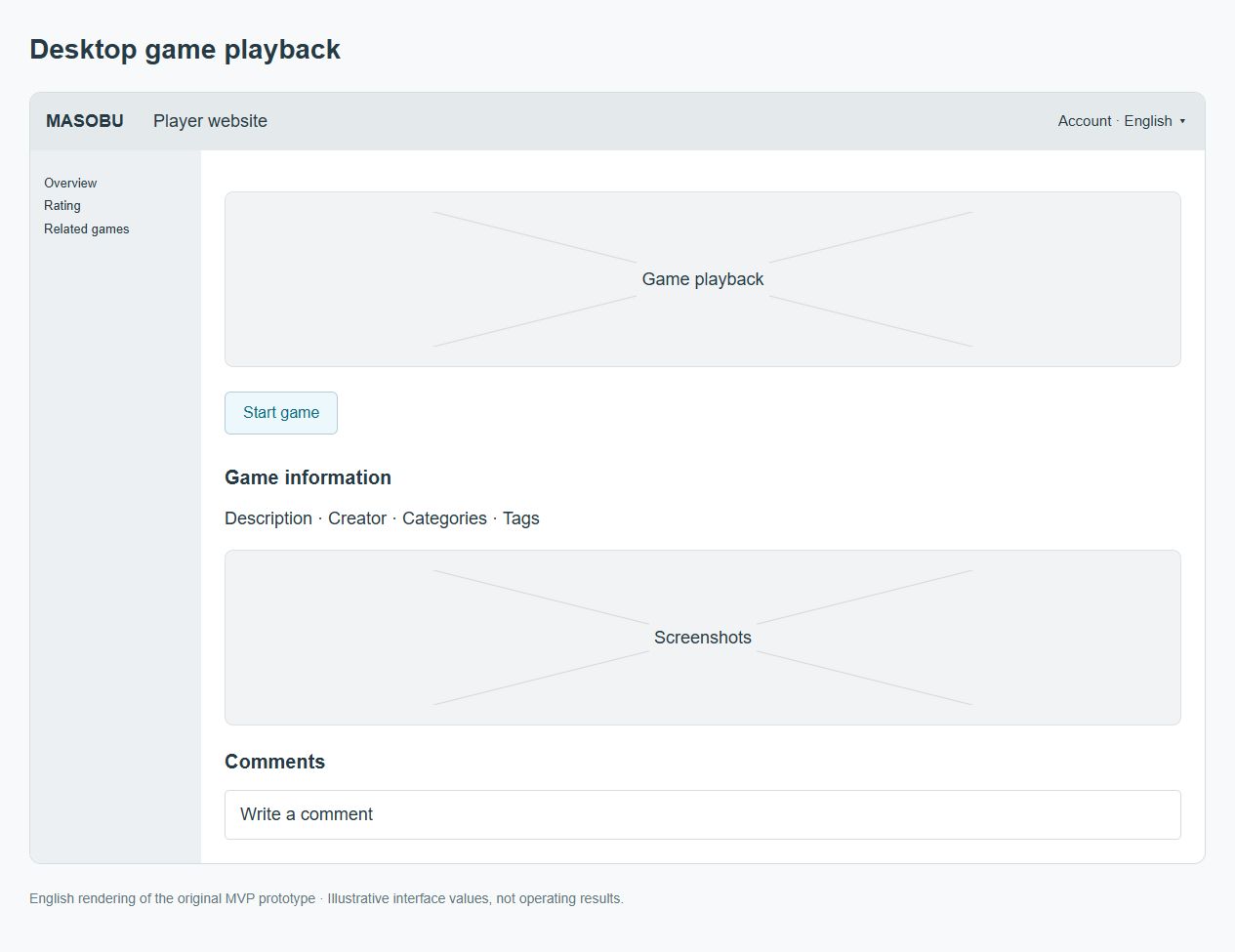
1.2 Registration and login

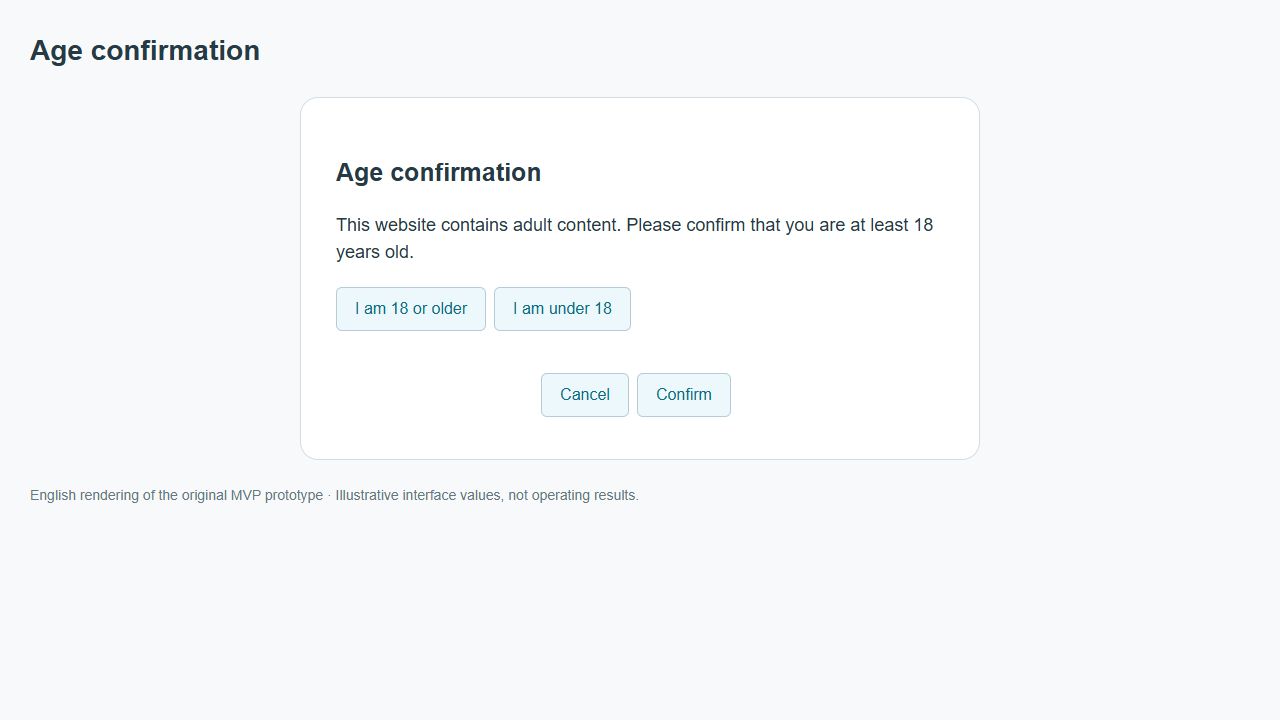
When a signed-out user clicks any of the following, display a registration/login dialog:
Type | Description | Dialog |
Entry point | Login button | Login dialog |
Register button | Registration dialog | |
Creator center | ||
Action | Start game | |
Like / favorite |
1.3 Top-up
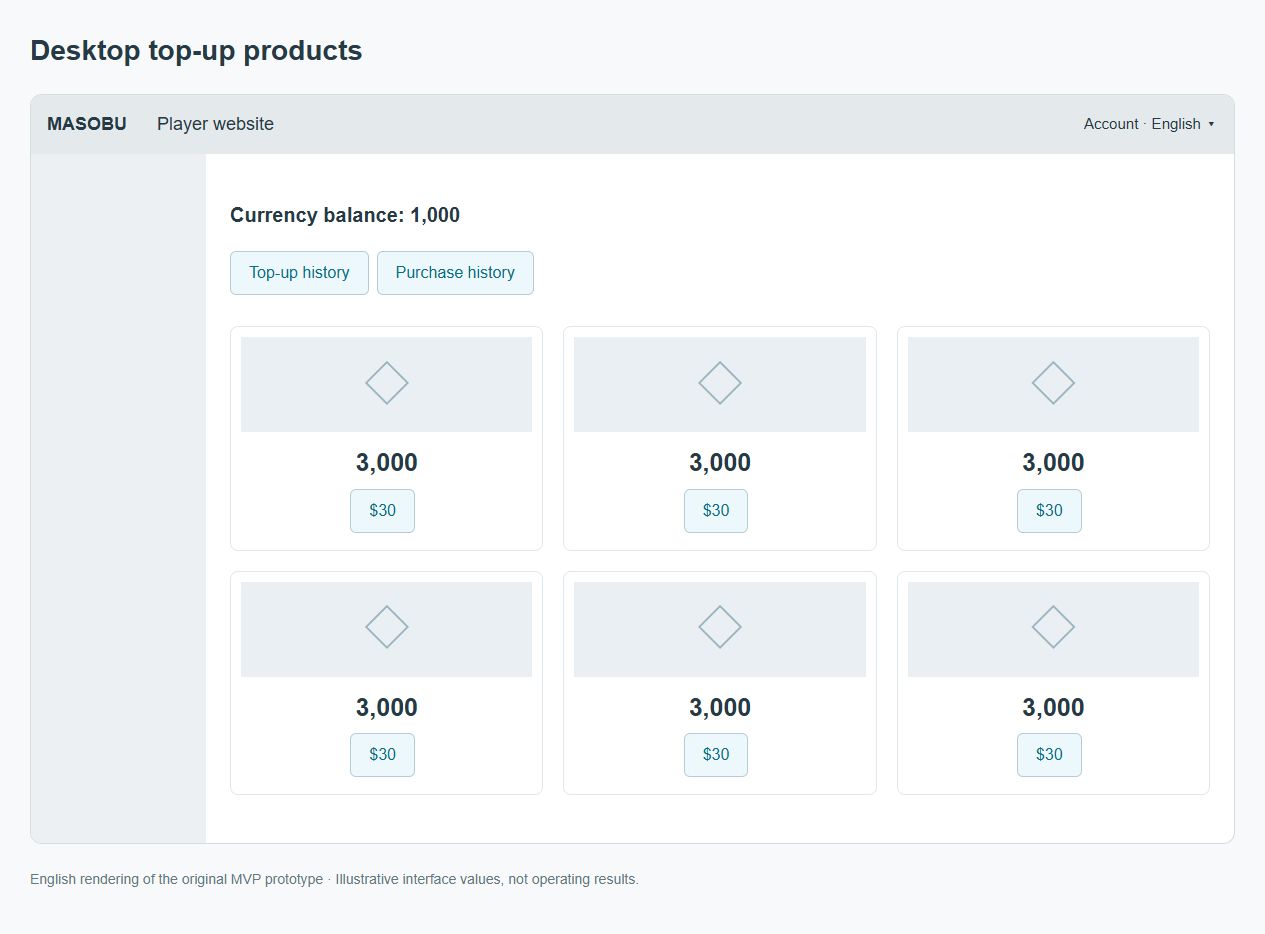
1.4 Personal center
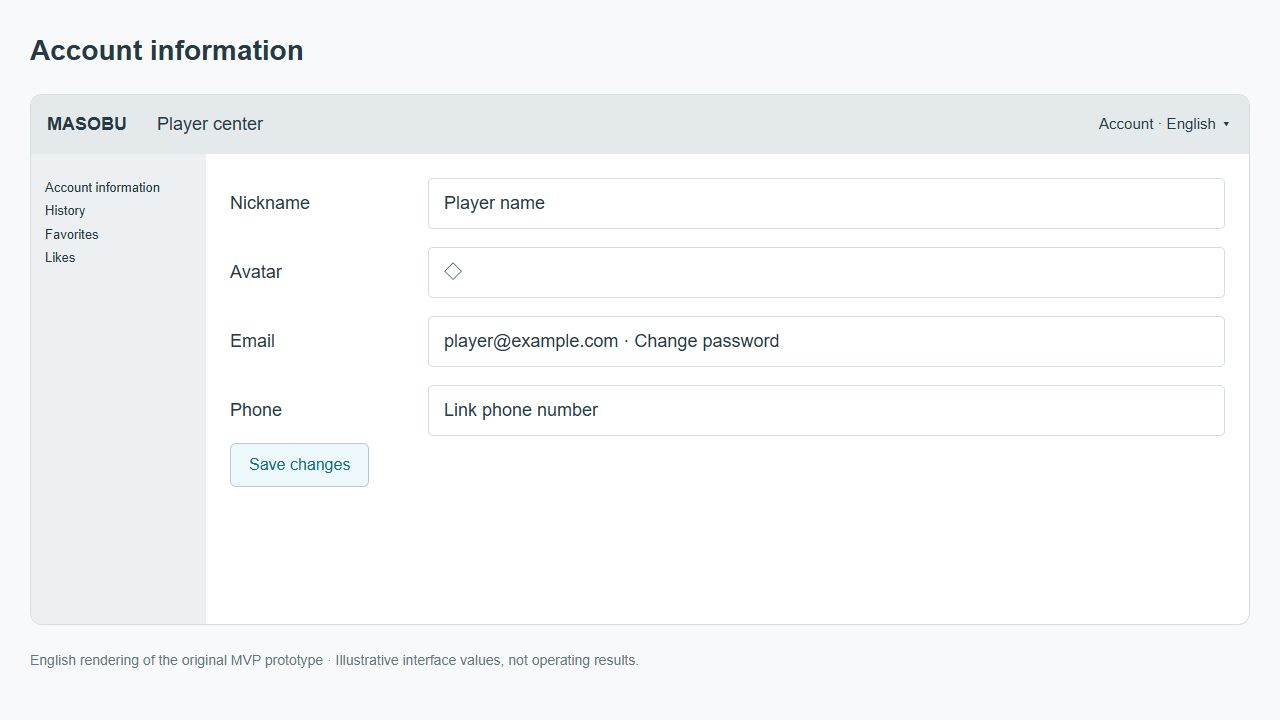
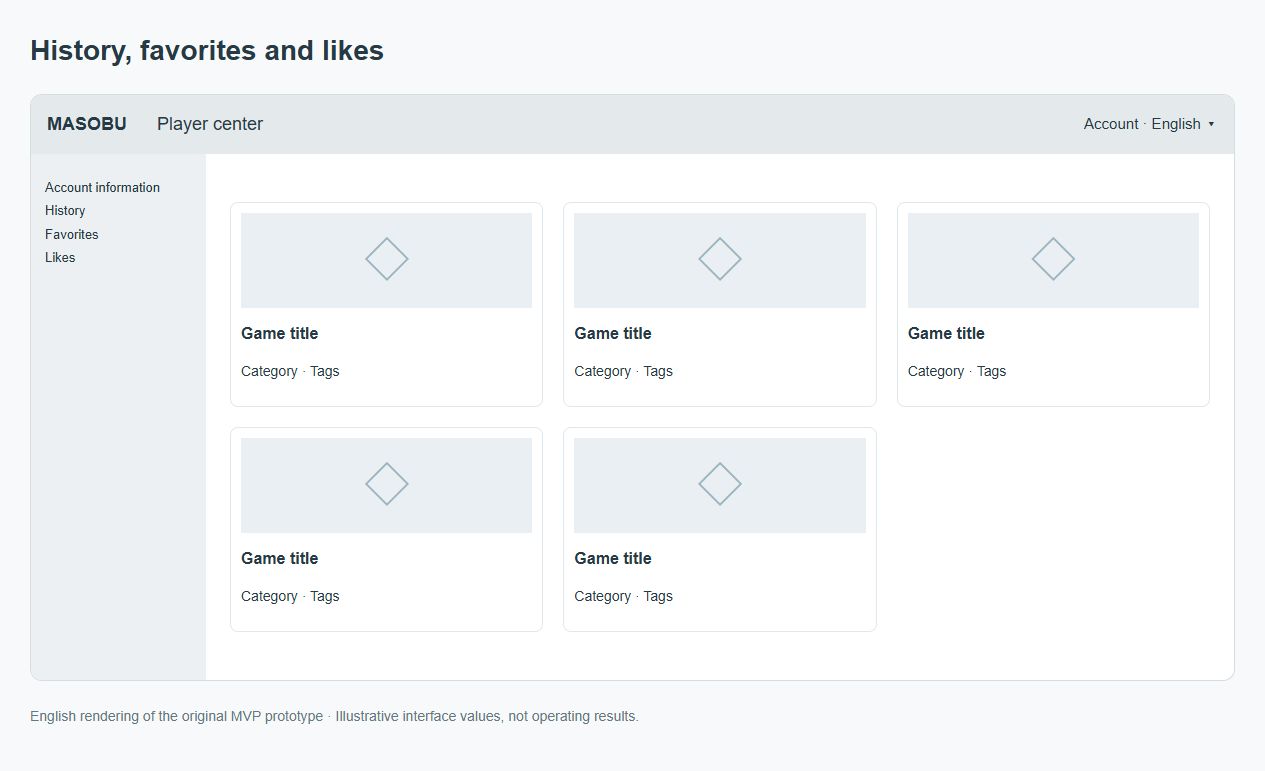
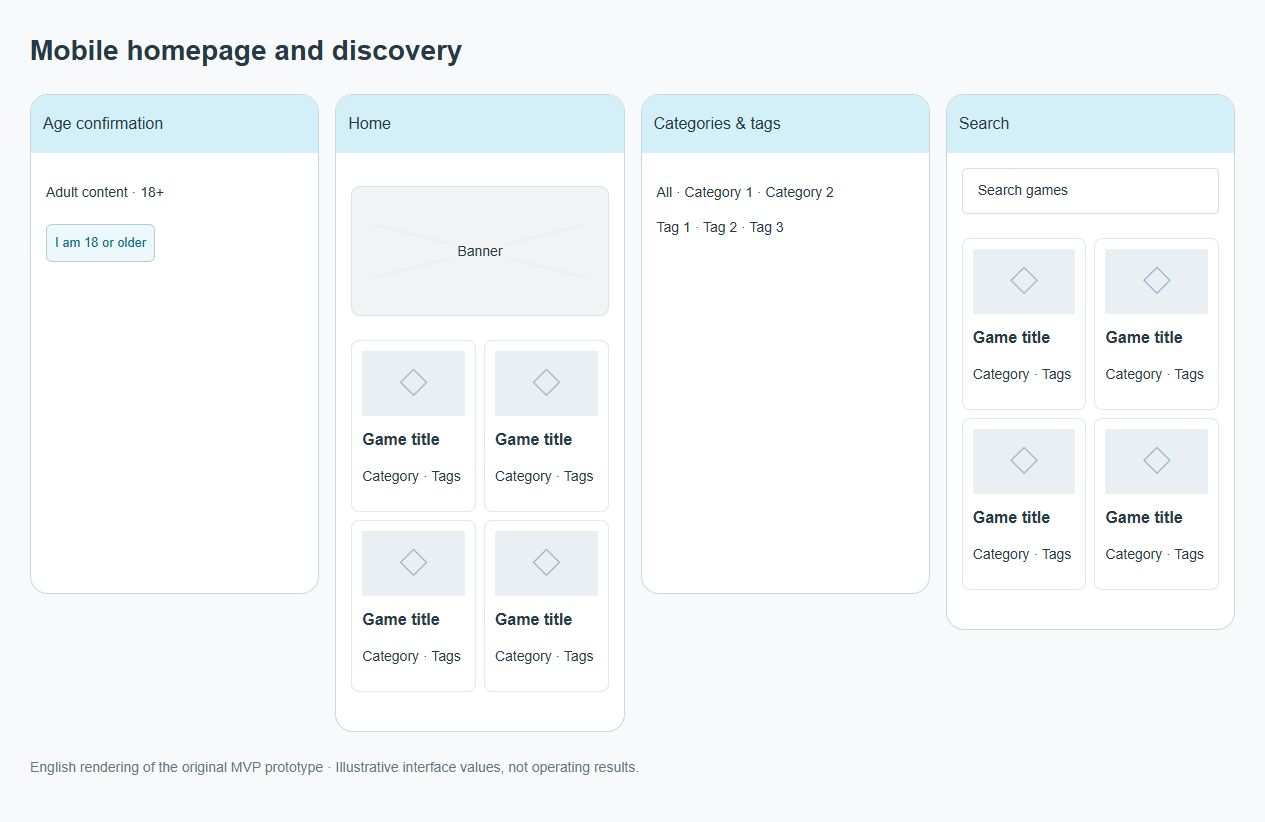
2. Player interface (mobile web)
2.1 Homepage
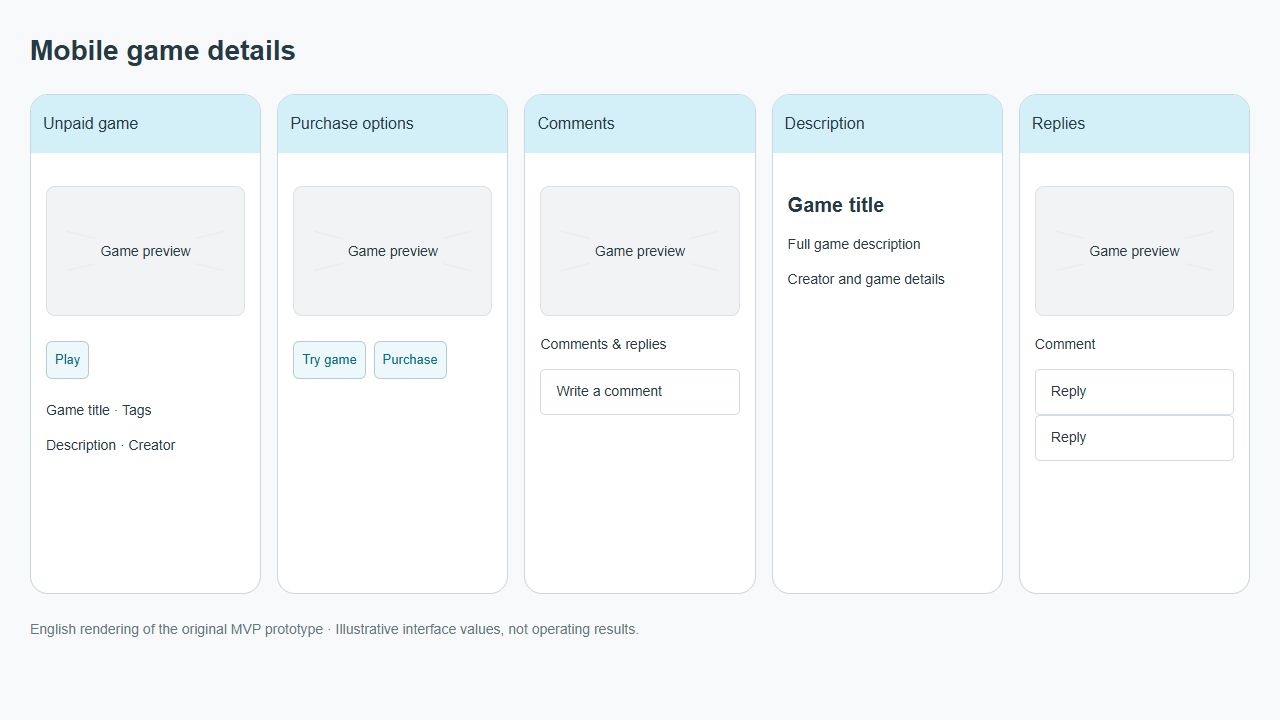
2.2 Details page
2.3 Registration and login
2.4 My account
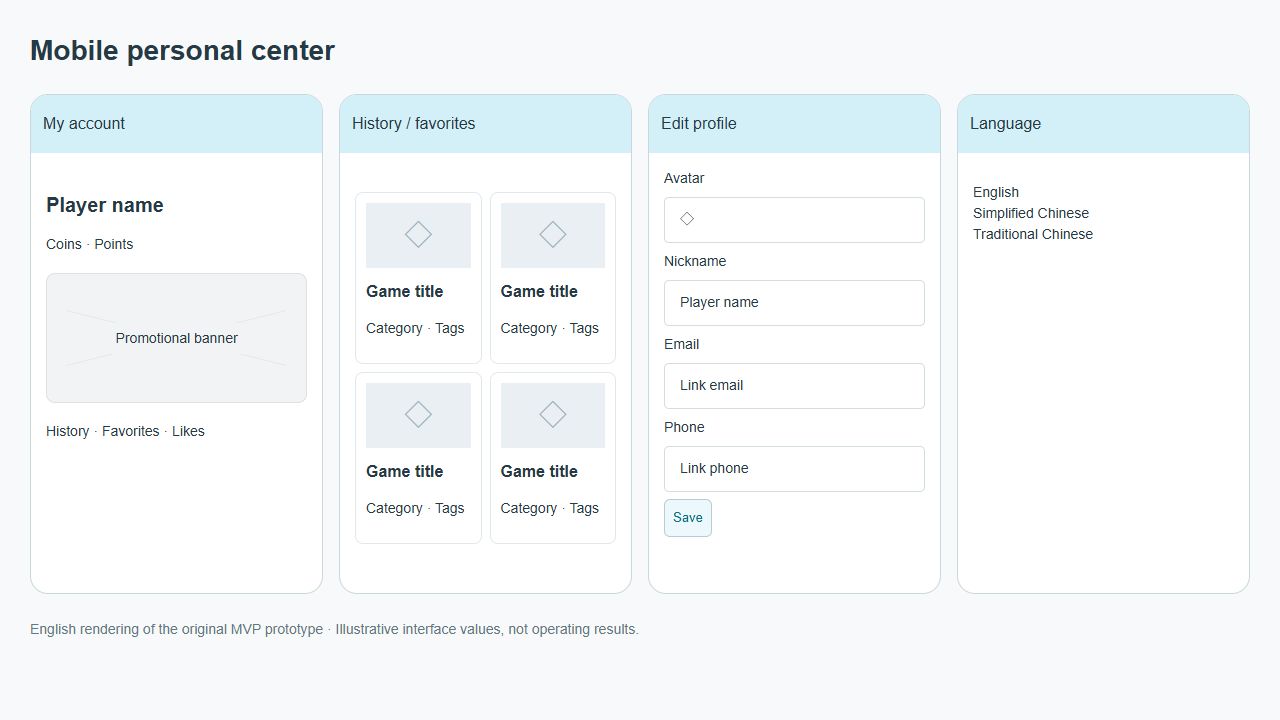
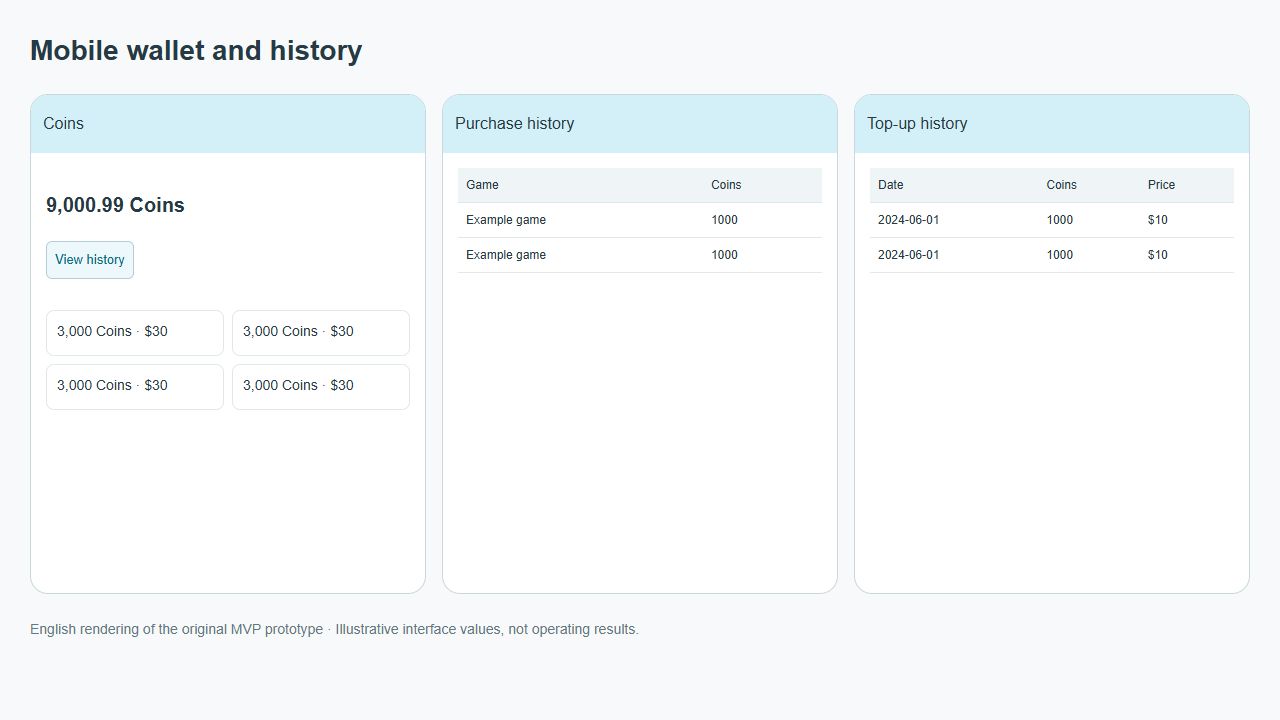
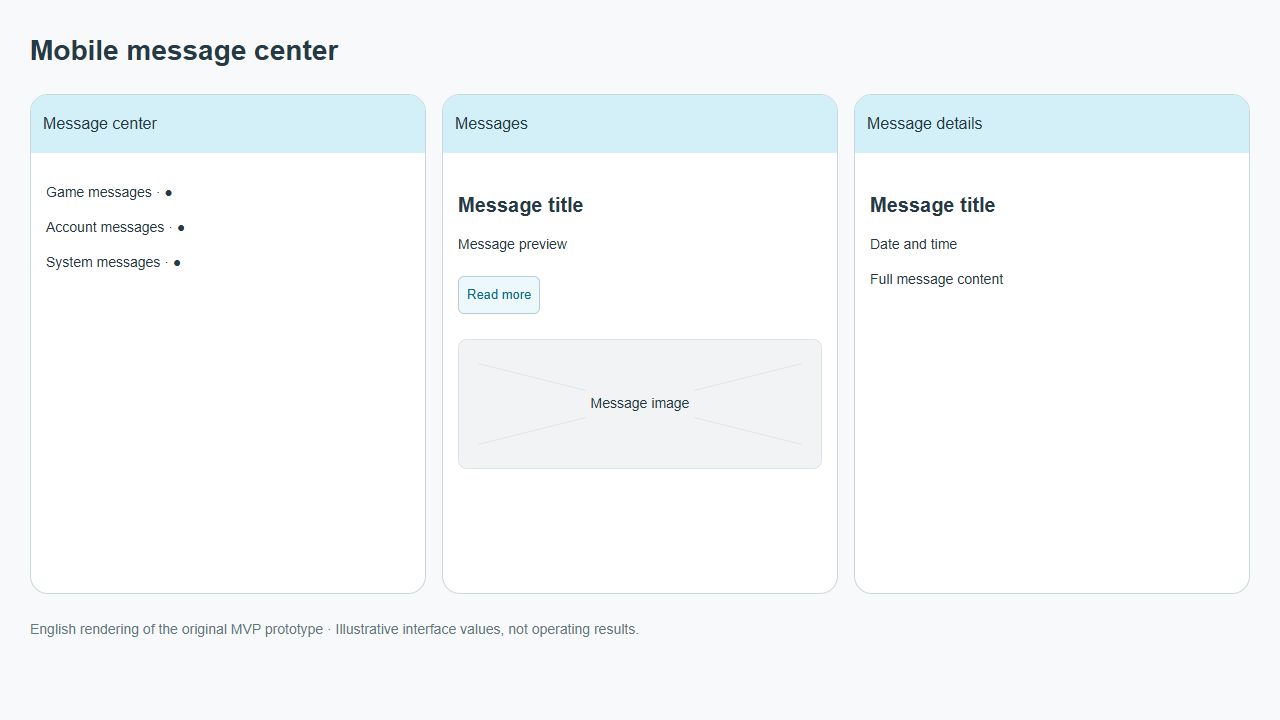
3. Creator interface
3.1 Game management
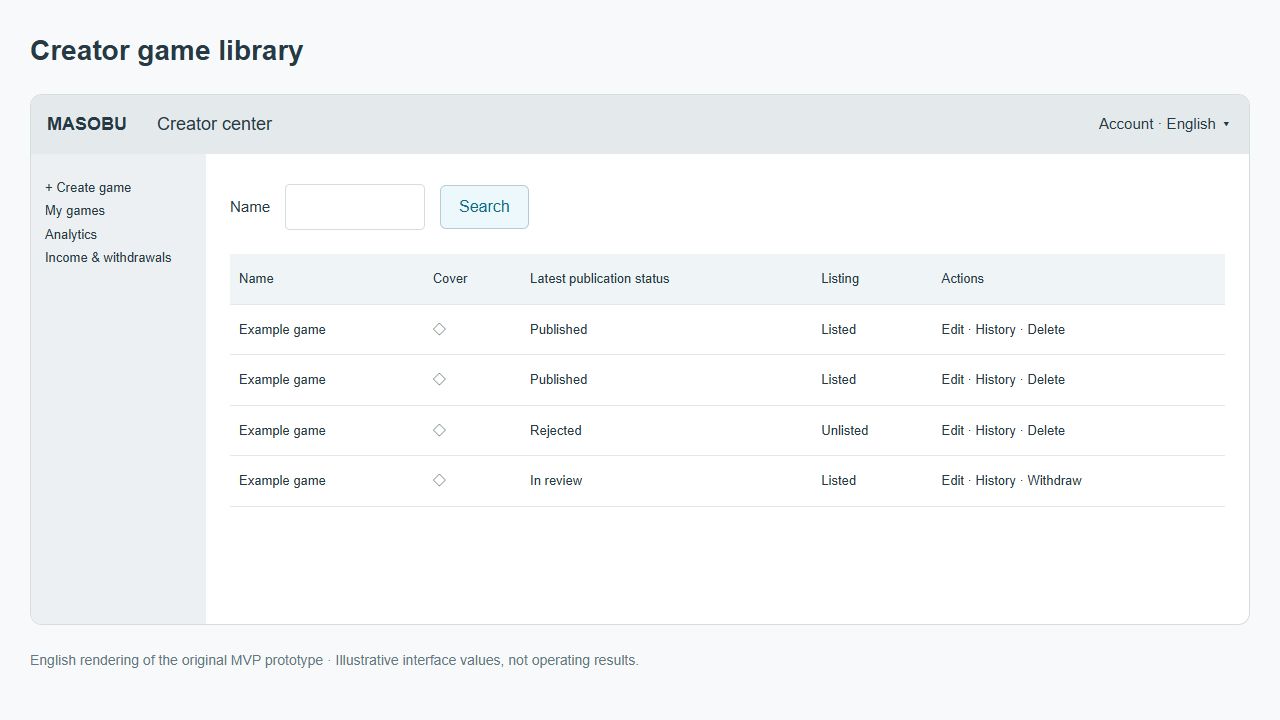
Latest publication status: the status of the most recent publication request
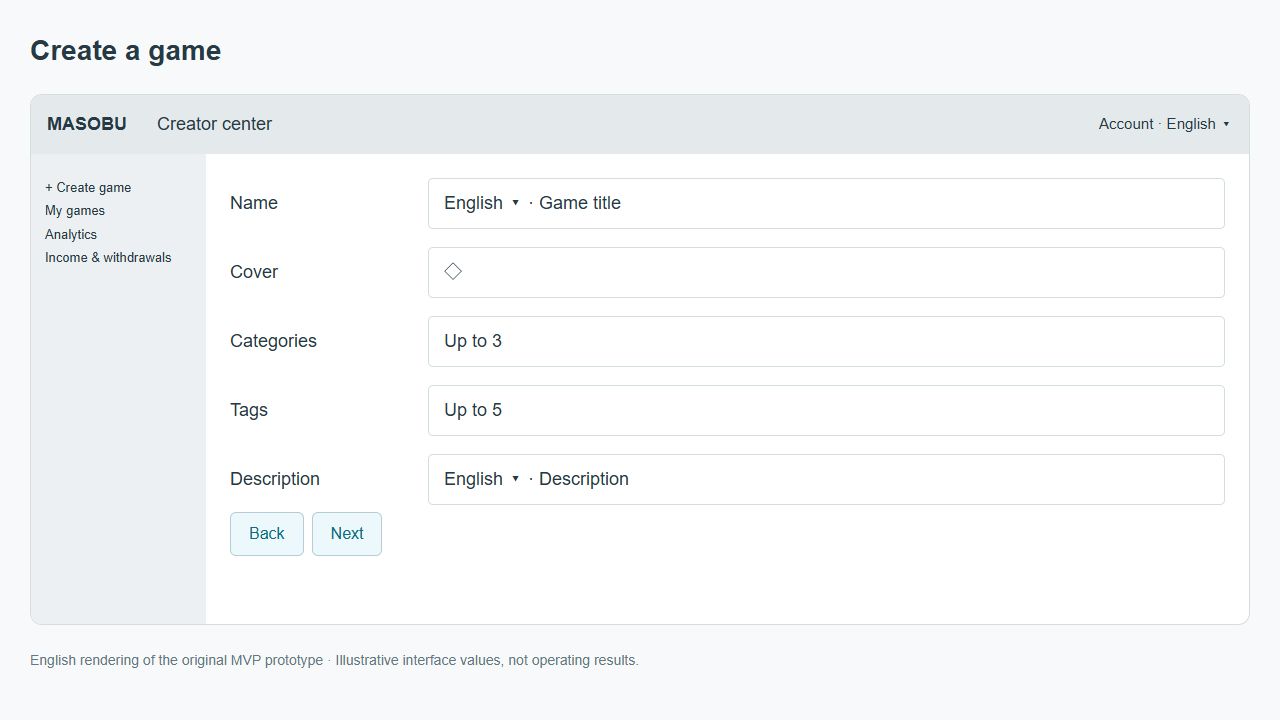
3.1.2 Create a game
3.2 Analytics
3.3 Income and withdrawals
4. Platform administration
4.1 Game management
4.1.2 Classification management
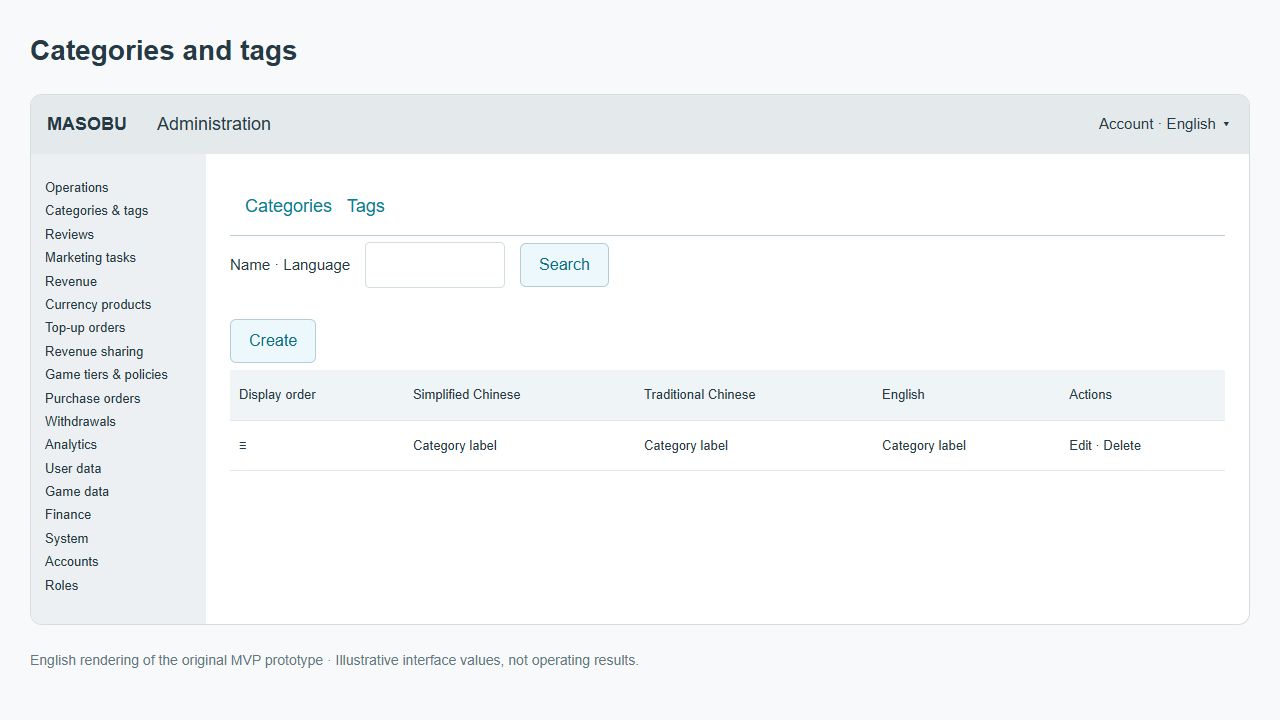
Higher-ranked options appear earlier in the tag selector
4.1.2 Review management
4.2 Marketing management
4.2.1 Task management
4.2 Revenue management
4.2.1 Virtual-currency products
4.2.2 Top-up orders
4.3 Revenue sharing
4.3.1 Revenue-share configuration
Game tiers:
Revenue-share policies:
4.3.2 Purchase orders
4.3.3 Withdrawal management
4.2 Analytics
4.2.1 User data
4.2.2 Game data
4.2.3 Financial analytics
4.3 System administration
4.3.1 Account management

4.3.2 Role management

| Task | Area | Priority | Status | Version |
|---|---|---|---|---|
| User account management | Players, creators, admin & SDK | P0 | New | Unscheduled |
| Track sign-up and top-up conversions in GA4 | Players & payments | P3 | New | — |
| Improve mobile page metadata | Players | P1 | In progress | v1.17 |
| Optimize the purchase API across embedded, Unity and H5 SDKs | SDK | P0 | Completed | v1.10.1 |
| Introduce a new customer support system | Players | P0 | Completed | v1.13 |
| Separate platform / SDK top-ups and free / paid game metrics | SDK & players | P0 | Completed | v1.13 |
| Preview game templates in the creator center | Creators | P1 | Completed | v1.13 |